An Infinite Game of the Mind: A Review of Angus Fletcher’s Primal Intelligence
9 December 2025
The Finite Trap of Modern Success
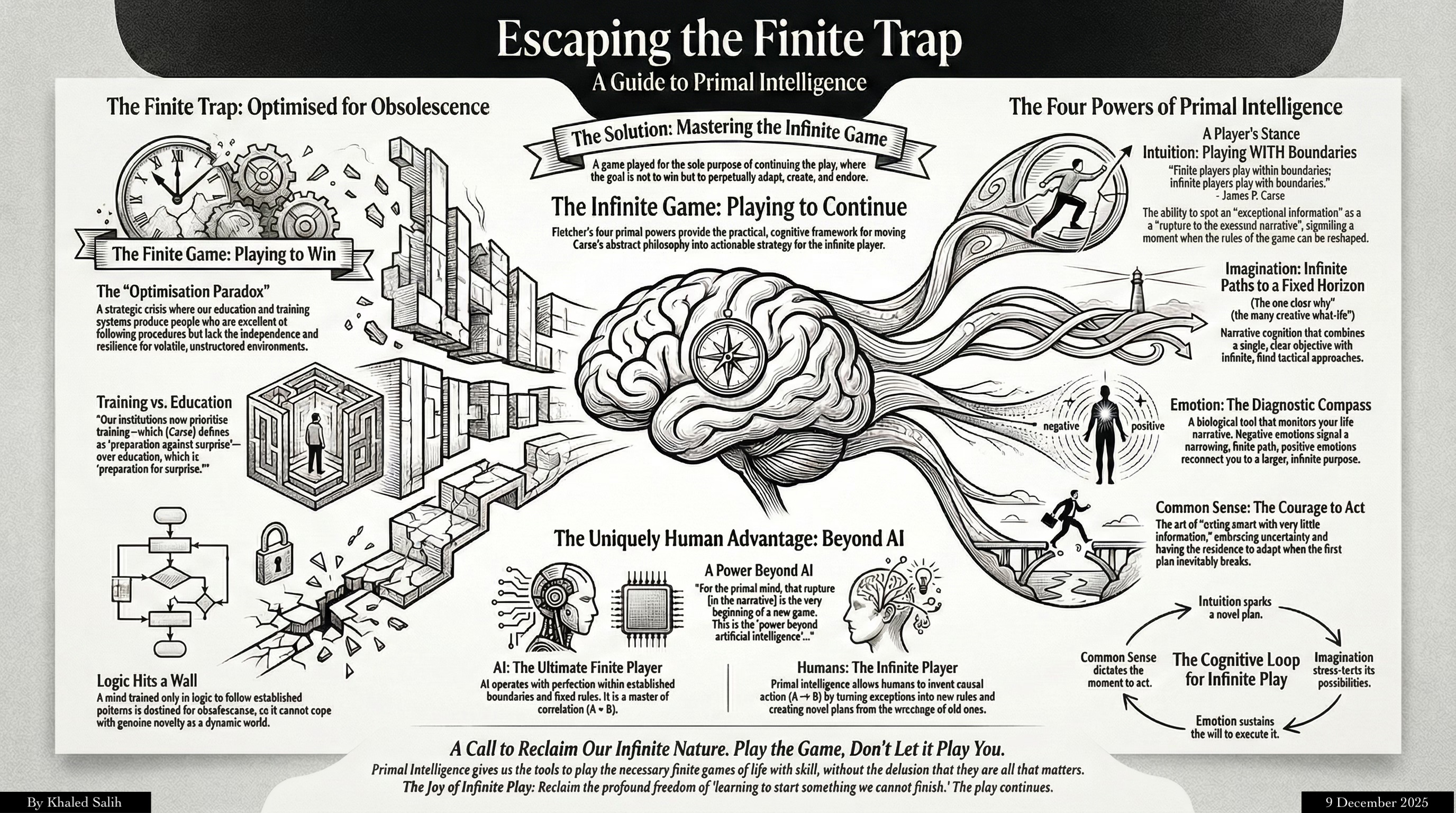
Our modern world has become dangerously infatuated with a narrow and brittle conception of intelligence. From the classroom to the boardroom, we are conditioned to value a single mode of thought: a logical, procedural, and algorithmic prowess geared towards standardised tests and quantifiable outcomes. We have, in essence, been trained from birth to play what the philosopher James P. Carse defines as a ‘finite game’: a contest played for the explicit purpose of winning, one that must, by its nature, come to a definite end. We are taught to master the rules, perfect the procedure, and win the title, forgetting that the victory itself marks the end of the play. It is a societal project to turn humans into inferior versions of the ultimate finite player—the algorithm.
Into this constrained and optimised landscape arrives Angus Fletcher’s Primal Intelligence, a work of profound and urgent insight. It serves as a powerful antidote to the finite trap. Fletcher’s book is not a mere collection of techniques for unconventional thinking; it is a revolutionary framework for reactivating the innate, adaptive, and non-logical genius that has long been our species’ greatest asset. It is the intelligence that thrives not in sterile certainty, but in the heart of chaos.
This review argues not merely that Fletcher’s work is compatible with Carse’s philosophy, but that Primal Intelligence inadvertently provides the first practical, cognitive framework for mastering the infinite game, moving Carse’s abstract principles from the realm of philosophy into actionable military and corporate strategy. An infinite game is played not to win, but for the sole purpose of continuing the play. Fletcher’s four primal powers—intuition, imagination, emotion, and common sense—are the very instruments required for this game of perpetual adaptation, creativity, and resilience. To understand his work through Carse’s philosophy is to grasp its true, transformative power.
This is the story of how our obsession with a winnable game has paradoxically made us less equipped to play at all.
The Peril of the Optimisation Paradox
To appreciate the genius of Fletcher’s solution, one must first grasp the gravity of the problem he was tasked to solve. The research behind Primal Intelligence was born not of abstract curiosity, but of an urgent strategic crisis identified by U.S. Army Special Operations. They observed a steep and worrying decline in the independence, adaptability, and resilience of their recruits. The very education system designed to produce successful citizens and warriors was, in fact, training out the essential skills needed to operate in “volatile, unstructured environments.” They were receiving soldiers optimised for following procedures in a world that increasingly punishes predictability.
This crisis is a perfect illustration of a society caught in a finite mindset. In Carse’s language, our institutions now prioritise training—which he defines as “preparation against surprise”—over education, which is “preparation for surprise.” We seek to furnish individuals with the power to control a predictable future, rather than the strength to endure an uncertain one. This logic-obsessed model, whether enacted in a school, a corporation, or a military, is designed to produce masters of a game whose rules are assumed to be static.
The profound failure of this model was keenly understood by a “seasoned computer-expert colonel” involved in the project. Aware of the mathematical limits of pure logic, he recognised that any system based on it, whether human or artificial, inevitably “hits a wall.” In a complex and dynamic world, a mind trained only to follow established patterns is a mind destined for obsolescence. The finite game, for all its seriousness and apparent necessity, simply cannot cope with genuine novelty.
Fletcher’s work offers the way out. The four powers of Primal Intelligence are the tools for escaping this finite trap and re-engaging with the world as infinite players.
The Four Powers: A Toolkit for the Infinite Player
Let us dive into each of Fletcher’s four primal powers, demonstrating how each one serves as a perfect instrument for engaging in what Carse defines as infinite play. They are not abstract concepts but tangible cognitive faculties for navigating a world without a script.
Intuition: Playing with Boundaries, Not Within Them
Fletcher’s first move is to reclaim intuition from its modern, diminished definition as mere fast pattern-matching. For him, primal intuition is something far more radical: the ability to spot an “exceptional information” or a “rupture in the standard narrative.” It is the cognitive alarm that sounds when a vital data point violates the established laws of its environment.
This provides the very cognitive machinery for the infinite player. Carse makes a crucial distinction: “Finite players play within boundaries; infinite players play with boundaries.” An infinite player must be sensitive to the moments when rules can be changed to continue the play. Fletcher’s intuition is precisely the cognitive event that signals such a moment; it is the trigger that allows a player to shift from following rules to reshaping them. Van Gogh, chasing the anomaly of green-purple, intuitively discovered the biological truth of the RGB colour system. In 2003 Baghdad, a special operator’s intuition, sparked by a single exceptional encounter with a Harvard-educated Iraqi engineer, allowed him to see that the entire U.S. strategy had failed years before Washington would admit it. He was playing with the boundaries of the official story, not within them.
Imagination: Forging Infinite Paths to a Fixed Horizon
Fletcher defines imagination not as idle fantasy but as a rigorous form of “narrative cognition,” organised into two modes: the “causal past story” that creates momentum and the “counterfactual future story” that generates adaptability. The ideal state for an operator is to have “one clear why joined with many creative what-ifs”—a fixed objective on the horizon, but infinite, fluid paths to reach it.
This is a sublime articulation of the mechanics of infinite play. The infinite player’s goal is not to win by following a single, rigid path, but to continue the play towards what Carse calls an “open horizon, a point that is continuously approached but never attained.” Fletcher’s why provides this horizon, and his what-ifs are the infinite tactical moves made to keep moving towards it. Nelson at Trafalgar gave his captains total tactical independence, bound only by the fixed strategic objective of annihilation. In the Dismal Swamp simulation, when the plan shattered, every operator acted differently, yet each action served the same “fixed objective.” This is the essence of infinite play: a clear and unwavering purpose that liberates, rather than constrains, tactical creativity.
Emotion: The Diagnostic Compass of the Dramatic Self
Perhaps Fletcher’s most profound insight is the re-framing of emotion. He presents it not as a disruptive force to be suppressed by logic, but as a “biological diagnostic tool” that monitors the integrity of one’s life narrative. Emotions like anger or fear are signals that one’s future is narrowing and becoming finite; positive emotions like “dumb pride” or “maverick gratitude” reconnect one to a larger, infinite purpose, healing the fractures in the self.
This framework provides the internal compass for what Carse calls the dramatic self. A finite player is theatrical, performing a scripted role for an audience. An infinite player, by contrast, is dramatic, engaging in “authentic participation” where they are seen “as that person playing and not as a role played by someone.” Fletcher’s emotional diagnostics ensure one remains this authentic, dramatic participant, open to being changed by the journey and capable of the endurance required for infinite play.
Common Sense: The Courage to Act in an Uncertain World
Finally, Fletcher defines common sense as the art of “acting smart with very little information,” governed by a crucial rule: “Match the newness of your plan to the newness of your environment.” This is not about having all the answers; it is about knowing when you do not and having the courage to act anyway.
This is the practical ethos of the infinite player made manifest. It is a total rejection of the finite player’s quest for control and predictability. It aligns perfectly with Carse’s assertion that the infinite player “chooses to play as a mortal,” embracing vulnerability and preparing for surprise rather than against it. This is not about crafting the perfect plan to prevent failure; it is about cultivating the resilience to act, adapt, and continue when the first plan inevitably breaks.
Thus, the four powers form a seamless cognitive loop fit for an uncertain world:
intuition sparks a novel plan,
imagination stress-tests its possibilities,
emotion sustains the will to execute it, and
common sense dictates the moment to act upon it.
Why Primal Intelligence is a Uniquely Human Game
Herein lies the ultimate validation of Fletcher’s work. Primal Intelligence does not merely offer a competitive edge; it defines the very territory where human cognition is, and will remain, sovereign over artificial intelligence.
Synthesising the insights from both Fletcher and Carse, we can construct a powerful argument. AI, with its foundation in logic, data processing, and pattern recognition, is the ultimate finite player. It operates with breathtaking perfection within established boundaries and fixed rules. As Fletcher’s research notes, “AI sees correlation (A = B).” It is the master of the existing game.
Primal intelligence, however, is the mechanism of infinite play. It is how humans “invent causal action (A → B)” by turning exceptions into new rules, imagining counterfactual possibilities, and creating novel plans from the wreckage of the old ones. AI cannot play with boundaries because it cannot perceive a “rupture in the standard narrative” as anything other than an error to be corrected. For the primal mind, that rupture is the very beginning of a new game. This is the “power beyond artificial intelligence” that the Army’s researchers were seeking—the capacity not just to solve problems, but to create possibility itself.
This is the uniquely human game, and Fletcher has given us back the rules.
A Call to Reclaim Our Infinite Nature
In the final analysis, Angus Fletcher’s Primal Intelligence is far more than a military doctrine or a corporate leadership manual. It is a philosophical and practical guide to breaking free from what Carse calls the “experienced necessity” of modern life—the pervasive feeling that we must play the finite games of career, status, and competition as if our lives depended on them.
Fletcher’s magnificent achievement is to provide the tangible how to Carse’s abstract what. He has given us the tools to perform what Carse describes as conscious “self-veiling”—to play the necessary finite games of our professions with skill and seriousness, but without the soul-constricting delusion that they are all that matters. We can play the role without forgetting the self who chose it.
This book is a call to reclaim our birthright. It is an invitation to engage in the “joyous play” that Carse describes, rooted in the profound freedom of “learning to start something we cannot finish.” Fletcher’s work gives us the courage to act on our primal powers, to junk the perfect logical plan when it no longer serves us, and to step boldly into the endless, creative, and uniquely human drama of existence. The play continues.
References:
James P. Carse, 1986, Finite and Infinite Games: A Vision of Life as Play and Possibility. New York, NY: The Free Press, A Division of Macmillan, Inc..
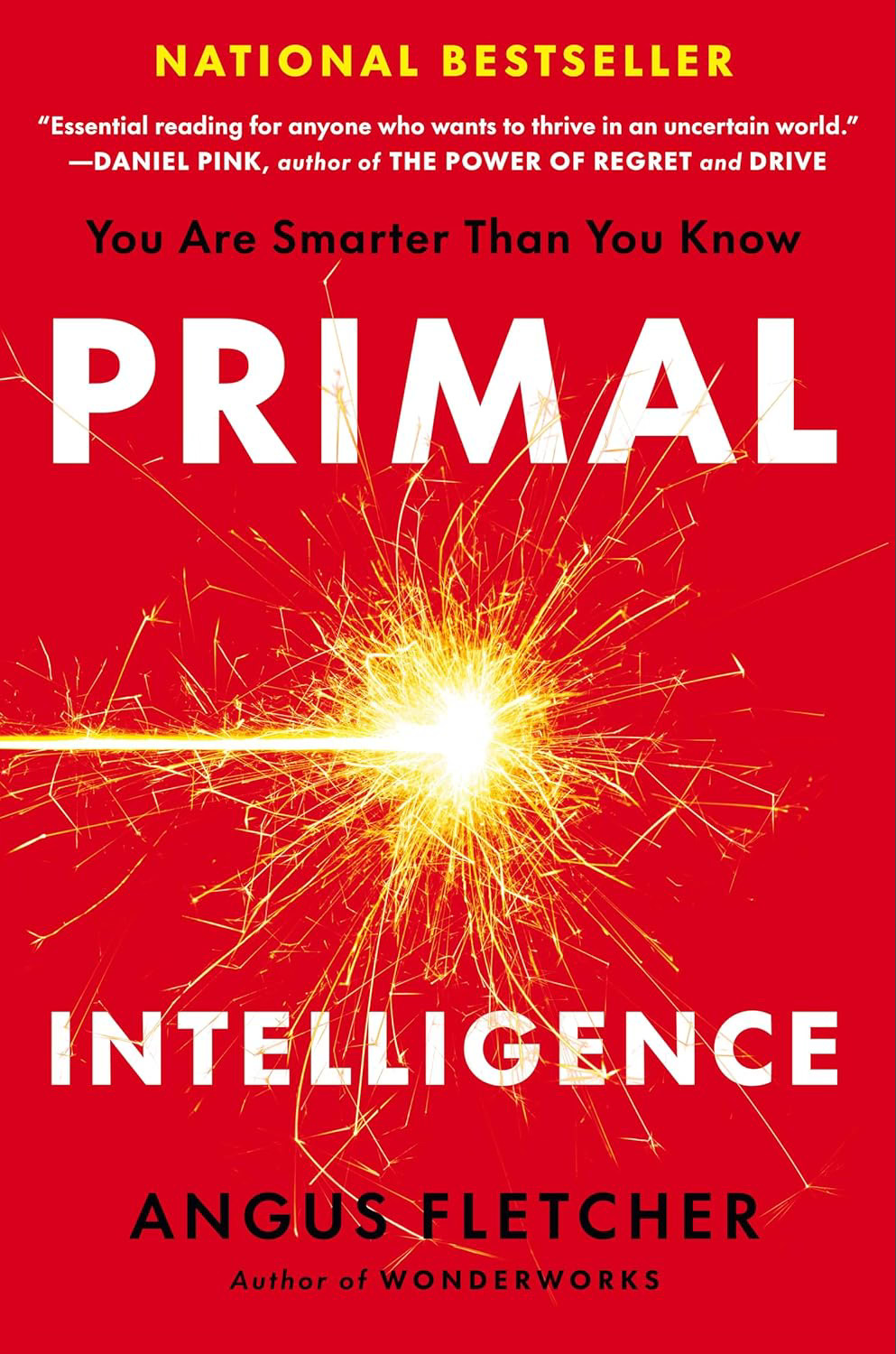
Angus Fletcher, 2025, Primal Intelligence: You Are Smarter Than You Know. New York: Avery.