An Antifragile State: Israel’s Military Strategy as an Infinite Game
By Khaled Salih
22 November 2025
Israeli’s Infinite Game visualised by NotebookLM
Let me be unconventional
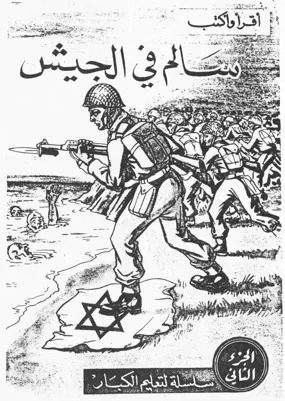
The cover of a primer, Sālim in the Army, used to teach reading and writing to Syrian soldiers.
It takes a truly Ba’athist level of neurological confusion to name your cartoon soldier Sālim — “the one who enforces peace” — and then depict him charging across a beach with a bayonet, promising to impose salām by stabbing anything shaped like a hexagram. This is the sort of linguistic irony that would normally provoke laughter, were it not drafted into the service of decades-long militaristic hysteria. In the regime’s imaginations, peace is not something achieved by, say, diplomacy or stability or literacy — it is something achieved by Sālim, the peace-enforcer, shoving steel into symbols and calling the resulting silence “harmony.”
And history, that merciless auditor of political pretension, has rendered its verdict. The man who was meant to impose peace on Israel never even managed to impose it on Syria, which has spent half a century descending into coups, massacres, and finally a national suicide conducted with barrel bombs. The only “peace” achieved by this schoolbook Messiah of the bayonet has been the graveyard sort, and most of it on his own side of the border. Meanwhile Israel — supposedly one stomp away from oblivion — persists. So much for Sālim the Peace-Enforcer: a mascot for a system that could not deliver peace, could not deliver victory, and could barely deliver the alphabet.
A New Framework for Protracted Conflict
A strategic post-mortem of the 2023-2025 Middle East conflicts reveals a masterclass in infinite-game theory, with Israel’s conduct serving as the definitive case study. In this paper I shall attempt to analyse Israel’s actions through the methodological framework I call “The Strategic Mind,” which applies James P. Carse’s game theory to protracted geopolitical conflict. The central thesis is that Israel’s objective is not merely to win finite wars, but to leverage them as instruments to perpetuate its ultimate infinite game: the continuation of the state, its security, and its culture. Israel’s behaviour demonstrates a sophisticated understanding that while finite games of war must be fought and won, they are subordinate to the unending imperative of survival.
Let me first define Israel’s core infinite game and the specific, embedded finite military campaigns it prosecuted. I will then analyse how these finite contests were waged not as ends in themselves but as strategic moves to strengthen Israel’s long-term position. Subsequently, I will analyse the cognitive and strategic mindset that enabled these actions, exploring the reliance on narrative, imagination, and adaptation. Finally, I will evaluate the outcomes of this two-year conflict as acts of poiesis—the creation of new strategic possibilities and the forging of a new regional landscape, which is the ultimate goal of the infinite player.
The Two Games of Israel: Defining the Strategic Landscape
In any geopolitical conflict, distinguishing between finite and infinite objectives is of paramount strategic importance. A finite game “is played for the purpose of winning,” while an infinite game is played “for the purpose of continuing the play.” The failure to differentiate between these two modes of engagement can lead a state to win a battle but jeopardise its long-term survival—a tactical victory that precipitates a strategic defeat. Israel’s conduct, however, reveals a clear, if implicit, understanding of this distinction. Its strategic posture is a masterclass in nesting finite contests within an overarching infinite purpose.
Israel’s Infinite Game: The Purpose of Continuation
Israel’s overarching Infinite Game is the perpetual continuation of the Jewish state’s existence, security, and cultural integrity. This is not a game with a defined endpoint or a final victory condition; its sole purpose is to endure and to ensure that future generations can continue the play. This non-negotiable, unending objective is perfectly encapsulated by former Prime Minister Golda Meir’s foundational statement on Israeli strategic identity:
“The Jews’ secret weapon is that we have nowhere else to go.”
This is the pure logic of the infinite game. When there is “nowhere else to go,” the concept of “losing” in a final sense is unthinkable. Every action, every war, and every sacrifice is subordinated to the single imperative of continuation. This is not a game played for territory or power in the finite sense; it is played for the right to keep playing.
The Embedded Finite Games: Contests with a Conclusion
A Finite Game is a contest with clear boundaries, fixed rules, and a declared winner, played for the purpose of concluding the contest. Between 2023 and 2025, Israel engaged in a series of distinct but interconnected finite games to defend its borders and eliminate immediate threats to its infinite game. As chronicled by Arthur Herman, these campaigns included:
- The Gaza War against Hamas (Operation Iron Swords): A campaign to dismantle the military and governing capabilities of the terrorist organisation in the Gaza Strip.
- The Campaign to Degrade Hezbollah in Lebanon: A series of covert and overt operations to cripple the leadership and military infrastructure of Hezbollah.
- The Neutralisation of the Houthi Threat: A response to missile and maritime attacks from the Iran-backed group in Yemen.
- The Strategic Reshaping of Syria post-Assad: A series of airstrikes following the collapse of the Assad regime to prevent hostile forces from securing advanced weaponry.
- The Twelve-Day War against Iran’s nuclear and military infrastructure: A decisive air campaign targeting Iran’s nuclear programme and military leadership.
A master strategist treats these finite battles “not as ends in themselves, but as moves within a larger game whose only objective is to keep playing.” Israel’s execution of these campaigns was not simply only about achieving victory on each battlefield, but about ensuring that each outcome strengthened its ability to continue its infinite game.
Next, I will analyse precisely how the outcomes of these violent, finite contests were strategically subordinated to the needs of Israel’s unending game of survival.
Waging Finite Wars for Infinite Ends
A successful infinite player leverages finite contests to strengthen their position for continued play, rather than viewing victory as a final destination. Each battle is an opportunity to reshape the strategic environment, change the rules of engagement, and enhance long-term freedom of action. In this section I will look closer into Israel’s major military operations between 2023 and 2025 to demonstrate how each was designed to achieve results that enhanced its long-term survival and strategic autonomy, thereby serving the infinite game.
Finite Game I: Dismantling Hamas in Gaza
The war in Gaza, codenamed Operation Iron Swords, was a necessary and defensive finite game initiated after the catastrophic intelligence failure of 7 October 2023. The stated objective was to “break the backs of both Hamas and Hizbollah,” as articulated by Arthur Herman, to eliminate an immediate existential threat on its southern border. This was not a war of conquest but a crucial, methodical campaign to restore the conditions necessary for Israel to continue its infinite game without the constant threat of mass-casualty terror attacks.
The military analyst Edward Luttwak, cited in Herman’s account, noted that the IDF’s estimated 50-to-1 kill ratio against Hamas combatants was “an incredible measure of success.” This metric, while stark, highlights the finite nature of the objective: the systematic destruction of an enemy’s capacity to wage war. By dismantling Hama’s tunnel network, eliminating its leadership, and destroying its rocket arsenal, Israel concluded this finite game in a way that directly served its infinite purpose of securing a future for its citizens.
Finite Game II: Crippling the “Axis of Resistance”
Israel’s campaigns against Hezbollah in Lebanon and the Houthis in Yemen were a masterclass in “playing with boundaries,” a key trait of an infinite player identified by Carse. The Mossad’s covert pager operation in September 2024, which wounded thousands of Hezbollah operatives, was not merely a tactical victory; it was an act that dissolved the perceived boundary of Hezbollah’s secure internal communications network—a non-physical space they believed was inviolable. This redefined the battlefield, demonstrating that even encrypted digital territory was not a safe haven. The subsequent precision airstrikes that eliminated Hezbollah’s leader, Hassan Nasrallah, and his successor, Hashem Safieddine, were a strategic redrawing of the regional rules of engagement.
It is one of those exquisite coincidences that could only occur in the Middle East, where the Almighty appears to have a sardonic sense of humour rivalled only by His apparent indifference. The Party of allāh (hizb allāh), commanded for so long by the allegedly divinely victorious Hassan Nasrallah (nasr allāh, Victory of allāh), and later passed to the impeccably pious Hashem Safī ad-Dīn (The Pure of the Religion, the one true faith that brooks no rivals, islām), has been systematically dismantled, its bunkers vaporised, its arsenal reduced to scrap metal, and its leadership roster trimmed with almost clerical precision by the air force, special forces, and intelligence services of a small country whose very right to exist these gentlemen spent their lives denying and tried to undermine. Somewhere in the smouldering ruins of Dahiyeh in Beirut, amid the twisted rebar and the acrid smell of high explosive, the irony hangs heavier than the dust: the Party of allāh, the Victory of allāh, and the Pure of the dīn, all brought low by the very infidels they promised to drive into the sea. If this is divine justice, it arrives with a distinctly tribal accent and a targeting pod. One almost wants to apologise to the Almighty for noticing that, on this occasion at least, Hashem’s aim was rather good. In Jewish tradition, “Hashem” (הַשֵּׁם) literally means “The Name” and serves as the primary, reverential substitute spoken by religious Jews when referring to God in everyday conversation and most prayer, deliberately avoiding pronunciation of the sacred Tetragrammaton (יהוה). Far from being a proper name like allāh, it is a conscious circumlocution born of awe and the ancient prohibition against uttering the ineffable divine name casually, so that what Arabic names like “hizb allāh,” “nasr allāh,” or hashem safī ad-dīn proclaim boldly and directly as attributes of God, Hebrew-speaking Jews express only indirectly by calling Him, with deliberate restraint, simply “The Name.”
These actions sent an unequivocal message that no proxy leader was safe and that the “encirclement by hostile neighbours,” Israel had faced for decades was being actively broken. By degrading these Iranian proxies, Israel was not just winning battles; it was disrupting the strategic architecture designed to threaten its long-term existence, thereby creating more space and time for its infinite game to continue.
Finite Game III: Decapitating the Hydra in Iran
The Twelve-Day War against Iran in June 2025 represents the ultimate example of a finite game waged to fundamentally alter the long-term strategic environment. As described by Herman, this was not a solo Israeli endeavour but a coordinated strategic gambit. After devastating Israeli Air Force strikes neutralised Iran’s air defences and eliminated key military commanders and nuclear scientists, “another air force—the U.S. Air Force—was gearing up for the coup de grace.” On June 22, “American B-2’s and cruise missiles smashed Iran’s biggest and most important nuclear facilities,” burying Tehran’s nuclear ambitions.
This combined operation was a direct strike at “the head of the hydra,” aimed not at retribution but at pre-emption on a generational scale. By working in concert with the United States to demolish Tehran’s nuclear programme and decapitate its military leadership, Israel executed a finite military operation with the infinite goal of ensuring the state’s survival for decades to come, free from the shadow of nuclear annihilation.
Having analysed what Israel did in its series of finite games, we now turn to an examination of the strategic mindset and cognitive capabilities that enabled these decisive actions.
The Cognitive Toolkit of the Infinite Player
An infinite player’s success is rooted not in superior resources alone, but in a specific cognitive toolkit that allows for adaptation, creativity, and resilience in a volatile environment. Israel’s strategic conduct is intelligible only through the lens of these faculties. As theorised by Angus Fletcher this toolkit relies on “Primal Intelligence”—a combination of narrative, imagination, and intuition that transcends pure logic—to navigate a series of cascading crises and emerge in a stronger strategic position.
From Prediction Error to Strategic Adaptation
The surprise attacks of 7 October 2023 represented a catastrophic intelligence failure. This shock represents what neuroscientist Nicholas Wright terms a “prediction error”—a biological signal that forces a radical update to a state’s strategic Model when reality violently collides with it. For a rigid, finite player, such a shock can be paralysing or game-ending. For an infinite player, however, it is a powerful catalyst for adaptation.
Israel’s subsequent two-year military campaign was the direct result of a radical update to its strategic model. The failures forced a complete reassessment of threats, capabilities, and necessary actions. This demonstrated the profound neurological plasticity required for infinite play: the ability to absorb a devastating blow, process the new information, and construct a new, more accurate narrative to guide future actions, transforming a moment of supreme vulnerability into a trigger for strategic renewal.
Imagination and Unlimited Tactics
Israel’s military performance exemplifies Fletcher’s concept of a trained imagination, structured as a “defined strategy, unlimited tactics.” The “one clear why”—the infinite game of survival—remains constant, while the “many creative what ifs” of tactical execution are endlessly generated. Nachum Kaplan argues that Israel’s military superiority is not a fixed inventory of weapons but an “ecosystem of innovation.” This is evident in numerous examples:
- Platform Modification: The transformation of the standard American F-35 into the F-35I Adir is a direct expression of this mindset. Where a finite player accepts the “rules” of a supplied weapons system, the infinite player asks the “what if” of reverse-engineering it to integrate proprietary systems, thus creating a new tactical possibility in service of the “one clear why” of national survival.
- Economic Innovation: The deployment of the Iron Beam laser, which intercepts threats for “a few dollars per interception,” ensures economic sustainability in protracted conflict. The system was named “Ohr Eitan”—Light of Eitan—in honour of a fallen soldier whose father contributed to its development, a detail that powerfully links technological advancement directly to the national narrative of collective sacrifice and defence.
- Covert Creativity: The meticulously planned pager operation against Hezbollah, requiring years of intelligence work and supply chain infiltration, showcases an imaginative approach to asymmetric warfare that goes far beyond conventional military tactics.
These actions demonstrate a culture of relentless problem-solving, where tactical possibilities are limited only by imagination, all in service of the singular, non-negotiable strategic goal.
Narrative, Identity, and the Identity-Culture Spiral
Sustaining motivation through a protracted, painful conflict requires a powerful and cohesive narrative. This is explained by Wright’s concept of the “identity-culture spiral,” where individual identity reinforces group culture, and vice versa, creating a resilient feedback loop. Israel’s identity as a “people’s army,” where citizens are fighting for the very survival of their state, creates a narrative cohesion that is difficult for its adversaries to match.
This deep cultural motivation was most evident in the national response to the hostage crisis. As Herman observes, despite internal divisions, “the Israeli people had a shared sense of concern for the hostages’ fate, and a shared and unconquerable desire to see them released.” This shared narrative transcended politics and provided a powerful, unifying purpose that sustained the nation through the darkest moments of the finite wars, reinforcing the collective commitment to the infinite game.
These cognitive capabilities—adaptation, imagination, and narrative cohesion—were the engine that produced the tangible strategic outcomes that reshaped the Middle East.
Poiesis: The Creation of a New Middle East
The ultimate goal of the infinite player, as defined by Carse, is not to achieve power over others but to engage in poiesis—the creative act of initiating new possibilities and ensuring the game remains open for future generations. The definitive proof of Israel’s success as an infinite player lies not merely in its tactical victories, but in the new strategic reality it forged from the crucible of conflict. Rather than emerging isolated and weakened as many predicted, Israel’s decisive military actions created a fundamentally new regional architecture.
Synthesising the analyses of Arthur Herman and Zineb Riboua, this new reality is characterised by three pivotal transformations:
- A Realigned Regional Architecture. Counter to predictions that the war would turn Israel into a pariah, it “accelerated the alignment Sinwar hoped to destroy.” The war served as a catalyst for deeper, covert military integration. Both Herman and Riboua note that CENTCOM deepened its operational coordination between the IDF and Arab armies, including those of countries that do not have formal relations with Israel. States facing Iranian pressure recognised that Israeli hard power was more valuable than the opinions of “Western university students.”
- The Genesis of New Economic Corridors. Israel’s victory solidified its position as the “geographic hinge” of the India-Middle East-Europe Corridor (IMEC). This is a direct act of poiesis. By demonstrating its indispensability to regional security, Israel anchored a framework offering a viable alternative to China’s Belt and Road Initiative. The strategic distinction, as Riboua notes, is profound: whereas China’s model “centralises influence,” the US/Israel-backed IMEC “distributes power across participating states.” This creates an open, continuing system—the hallmark of an infinite player—that fundamentally alters the geoeconomic landscape for decades to come.
- The Irrelevance of Old Paradigms. Perhaps most significantly, Israel’s actions rendered “the Israel boycott movement, and the siren calls for a Palestinian state... irrelevant,” as Herman concludes. By breaking the Iranian-backed “axis of resistance” and deepening its integration with pragmatic Arab states, Israel fundamentally changed the rules of the game. The old diplomatic frameworks were superseded by a new reality based on demonstrated power and shared strategic interests. This is the hallmark of a successful infinite player: not just winning the game, but forcing all other players to adapt to a new board of one’s own making.
These acts of creation—forging new alliances, new economic pathways, and new diplomatic realities—set the stage for the continuation of Israel’s infinite game.
The Antifragile Player and the Unending Game
Israel’s strategic conduct from 2023 to 2025 is a definitive example of an antifragile, infinite player in action. It demonstrates a clear capacity to leverage the shocks, chaos, and outcomes of violent finite games not merely to survive, but as catalysts for growth, adaptation, and strategic renewal. Facing an existential threat, Israel updated its strategic model, waged a series of decisive finite wars, and emerged not weaker or more isolated, but as the indispensable anchor of a new regional security architecture. It treated each battle not as an end, but as a move to perpetuate its ultimate game: the continuation of the state.
Arthur Herman concludes his analysis with the vision of a potential “golden age of Israel, and the golden age of the Middle East.” This future is not guaranteed, nor is it a sign that the game is over. Rather, it is the ultimate expression of poiesis. It represents the successful creation of a new set of possibilities, a new game board with new rules and new opportunities. For the infinite player, this is the only form of triumph. Its victory is never final but is measured solely by the continuation of the game into an open and unwritten future.
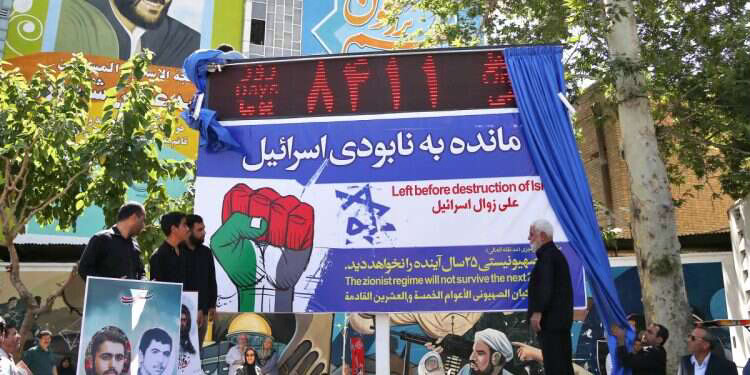
Gone is the iconic symbol of Iran’s Finite game: Iranian Protesters unveil a digital countdown showing “8411 days” until Israel is destroyed at the Palestine Sq in Tehran, Iran, Friday, June 23, 2017 | Photo: AP/Ebrahim Noroozi
In the end, Iran’s vaunted “Ring of Fire” proved nothing more than a bonfire of Tehran’s vanities – each proxy war it sparked only strengthened Israel’s resolve and spurred an even more ferocious counterstrike . From Gaza to Lebanon, from Yemen to a collapsing Syria, Israel systematically severed every Iranian tentacle – dismantling Hamas in Gaza, defanging Hezbollah in Beirut, neutralising the Houthis in Yemen, and preempting chaos in Syria’s ruins – with unsparing precision . Having thus cut off each limb of the Octopus strategy, Jerusalem delivered the coup de grâce at the head: a twelve-day air campaign that shattered Tehran’s nuclear program and decapitated Iran’s military leadership in its own capital. In doing so, Israel not only survived an existential siege but fundamentally changed the rules of the region – forcing every player to adjust to a new reality drawn up in Jerusalem rather than Tehran, Damascus, Beirut or Gaza City.
References:
James P. Carse, 1986, Finite and Infinite Games: A Vision of Life as Play and Possibility. New York, NY: The Free Press, A Division of Macmillan, Inc..
Angus Fletcher, 2025, Primal Intelligence: You Are Smarter Than You Know. New York: Avery.
Arthur Herman, 202511, “The Strategic Fruits of Israel’s Military Victory. Israel contra mundum.” https://ideas.tikvah.org/mosaic/essays/how-israel-changed-the-face-of-the-middle-east
Jews and Other, “Anti-Semitic and Anti-Israel Cartoons.” https://www.jewsandothers.com/cartoons/
Nachum Kaplan, 20251121, “Beyond the F-35: The weapons, networks, and intelligence that keep Israel ahead of its rivals.”

Zineb Riboua, 20251120, “How Israel’s Victory Strengthens America’s Hand.” https://ideas.tikvah.org/mosaic/essays/responses/how-israels-victory-strengthens-americas-hand?queryID=6461f346cca75edb6a6c612384cd84e4
Khaled Salih 20251026, “Netanyahu and Trump: Masters of the Long Game.” https://substack.com/home/post/p-177200350
— 20251019, “War of Revival at the Core of Israel’s Antifragility.” https://substack.com/home/post/p-176597531
Nicholas D. Wright, 2025, Warhead: How the Brain Shapes War and War Shapes the Brain. New York: St. Martin’s Press.



