A Three-Point Diagnosis: A Comparative Analysis of Deutsch, McGilchrist, and Vellend
28 January 2026
A Bridge
My two published articles—introduced under “Forging the Tools of Thought”—were written as a paired foundation.
In “A Memorandum on the Solvability of Human Problems,” I set out an orientation: the conviction that human problems are not fated to remain permanent fixtures of history, but can be progressively solved through better explanations, better institutions, and more rigorous ways of thinking. In “The Two Worlds: A Unified Framework for Analysing Ideas,” I charted a method: a disciplined way to distinguish between the inner world of concepts and narratives and the outer world that resists them, and to track how ideas move between these domains—sometimes clarifying reality, sometimes replacing it with a convincing substitute.
This essay, “A Three-Point Diagnosis: A Comparative Analysis of Deutsch, McGilchrist, and Vellend,” is a direct follow-up to that published work (in addition to my “The Gad Saad Scalpel: A Master-Framework for Clear Thinking.”) It is not a new beginning, but a continuation—an attempt to apply the same commitment to solvability and conceptual clarity to three large, ambitious explanatory systems that each claim to illuminate the deep structure of human life.
Why these three? Because each one offers a distinct kind of intellectual instrument. Deutsch foregrounds progress through the growth of knowledge and the power of good explanations. McGilchrist diagnoses a civilisational failure of perception—how a culture can become cognitively and spiritually distorted by the very modes of thinking that make it powerful. Vellend offers an evolutionary “algorithm” that can describe change across biology and, by extension, across culture and ideas.
The aim here is not to canonise any one thinker, but to use all three as a set of diagnostic lenses. The comparison is a way of pressure-testing my earlier commitments: if we claim that problems are soluble and that ideas can be analysed across “two worlds,” we also need a framework for detecting where modern thought goes wrong—how abstractions become idols, how explanations become unfalsifiable, and how selection pressures shape what ideas survive, regardless of whether they are true.
This essay therefore reads as a three-point diagnosis:
- an evolutionary diagnosis of how ideas replicate and compete,
- a cognitive diagnosis of how styles of attention and interpretation distort what we take to be real, and
- an epistemic diagnosis of what counts as a strong explanation rather than a persuasive story.
Taken together, these lenses serve the same overarching project as the two published essays: forging tools of thought robust enough to confront modern complexity without surrendering either to naïve optimism or to cynical fatalism—tools that can protect progress from the pathologies that progress itself can generate.
Three Architects, Three Lenses
In an era of bewildering and accelerating change, a few intellectual architects have dared to construct comprehensive, unifying theories to explain the complex systems that govern our world. David Deutsch, Iain McGilchrist, and Mark Vellend each offer a coherent blueprint for understanding the engines of knowledge, consciousness, and evolution. In this exercise I shall undertake an unusual analytical mission: rather than simply summarising their ideas, I shall employ the core framework of each thinker as a critical lens to diagnose and evaluate the other two. This three-point diagnosis creates a multi-faceted comparative analysis, turning their powerful philosophies back on each other to generate deeper insight.
The Evolutionary Lens
Mark Vellend’s concept of a generalised, “substrate-neutral” evolutionary theory provides a powerful algorithmic framework for understanding change in any system, be it biological, cultural, or intellectual. His Second Science posits that wherever there is variation, inheritance, and differential success, the principles of evolution apply. This section will use Vellend’s core principles as a diagnostic tool to deconstruct the intellectual and cultural dynamics described by David Deutsch and Iain McGilchrist.
Deutsch’s Knowledge Creation as Runaway Adaptive Evolution
When viewed through Vellend’s lens, David Deutsch’s entire philosophy of knowledge creation maps almost perfectly onto the model of runaway adaptive evolution. In Deutsch’s universe, the core evolutionary activity is not biological reproduction but the relentless creation of deeper and better explanations about reality. The components align with striking precision:
- Replicators: The fundamental units being selected and copied are good explanations. These are not merely ideas but hard-to-vary, causal accounts of reality.
- Variation: The source of novelty is conjecture. Human minds generate creative, fallible guesses that are not derived from sensory experience but are genuine acts of creation.
- Selection: The selective environment is defined by rigorous criticism and testing. Explanations compete, and only the fittest survive this demanding process.
- Fitness Criteria: The fitness of these explanatory replicators is determined by two key traits: their hard to vary quality, meaning they are so constrained by logic and reality that they cannot be easily altered, and their explanatory reach, their ability to explain phenomena far beyond the problem they were initially designed to solve.
- The Engine of Progress: This evolutionary process is open-ended. For Deutsch, solving one problem with a good explanation inevitably generates new problems and new selection pressures. This perpetual cycle of problem-solving is what he calls The Beginning of Infinity, a process of progress that can, in principle, continue forever.
McGilchrist’s Hemispheric Battle as Cultural Selection
Iain McGilchrist’s sweeping analysis of civilisational change—framed as a battle between the worldviews of the brain’s left and right hemispheres—can be powerfully diagnosed through the lens of cultural evolution. The Left Hemisphere’s (LH) worldview has often held a distinct selective advantage, especially in recent centuries. Its toolkit of abstraction, categorisation, and manipulation provides immediate, tangible payoffs like utility, power, and the control needed for resource accumulation. Furthermore, the LH’s models tend to be simpler and more explicit, making them easier to copy, teach, and institutionalise—a major fitness advantage for any cultural replicator.
This dynamic allows us to diagnose McGilchrist’s core concern of Left Hemisphere Capture as a classic case of positive frequency dependent selection. This evolutionary mechanism describes a self-reinforcing loop where the success of a trait increases as it becomes more common. As the LH worldview became more dominant, it shaped the environment—social structures, economic systems, technology, and institutions—in its own image. This environment, in turn, further selected for and rewarded LH-style thinking, making it seem ever more necessary and successful, regardless of whether it grasped the whole of reality. It creates a cultural hall of mirrors, where the paradigm’s success endlessly confirms the paradigm itself, linking an ecological mechanism to the potential psychiatric or civilisational pathology McGilchrist fears. This algorithmic perspective sets the stage for a deeper look into the cognitive and psychological styles that drive these systems.
The Cognitive Lens
Iain McGilchrist’s Divided Brain hypothesis serves as a uniquely powerful diagnostic tool for assessing the cognitive style and potential biases of intellectual frameworks. He posits a fundamental distinction between the Right Hemisphere (RH)—the Master that perceives the whole, the living context, and implicit reality—and the Left Hemisphere (LH)—the Emissary that abstracts, creates explicit maps, and seeks utility and control. This section will use this cognitive distinction to analyse the underlying architecture of Deutsch’s and Vellend’s intellectual projects.
Diagnosing Deutsch: An LH Architecture with an RH Requirement
David Deutsch’s entire philosophical system can be seen as a quintessential, highly sophisticated Left Hemisphere project. Its core characteristics are deeply aligned with the Emissary’s mode of operation:
- Primacy of Abstraction: It elevates abstract, explicit, universal theories—the good explanations—as the sole engine of human progress, prioritizing linguistic knowledge above all else.
- Map Over Territory: Its radical anti-empiricism, which posits that sensory experience tells us nothing directly, prioritizes the internal model or theory over the raw, embodied encounter with reality.
- Inherent Optimism: Its conviction that all problems are soluble aligns with the LH’s known role as the brain’s “interpreter,” which confidently spins coherent narratives, even with incomplete information.
Yet, a central paradox lies at the heart of Deutsch’s system. While its methodology is predominantly LH—focused on creating and manipulating explicit theory—its crucial mechanism of error correction implicitly relies on RH-style insight. The ability to perceive when the map no longer fits the territory, to spot inconsistencies, and to recognize the need for a new conjecture is an act of seeing the whole picture that the LH, by its nature, struggles with. Deutsch’s system demands the outcome of RH perception, even as its architecture and emphasis remain staunchly LH-designed.
Diagnosing Vellend: The Pinnacle of Abstract Utility
Mark Vellend’s Second Science represents the pinnacle of the LH’s ambition to create a universal, content-free “theory of everything.” The project’s goal is to reduce the messy, specific, lived reality of countless different systems to a set of clean, abstract variables that can be modeled and manipulated. Vellend’s self-identification as a “pragmatic” scientist is telling; this focus on creating a useful, instrumental map aligns perfectly with the Emissary’s core function. The goal is utility and control—to build a tool that works—rather than to capture the unique, holistic, and perhaps RH-perceived reality of any single evolving system.
This diagnosis highlights the crucial difference in McGilchrist’s own methodology. Where Deutsch and Vellend build purely LH architectures, McGilchrist undertakes the more difficult task of using the Emissary’s tools—careful language and detailed analysis—to articulate the Master’s worldview. His approach is holistic, drawing not just on neuroscience but on philosophy, poetry, and art history to evoke the interconnected whole that the RH perceives. This methodological contrast is itself a powerful piece of evidence for his thesis: the core insight that the Emissary has usurped the Master can only arise from the RH’s perspective of a broken whole. It is a diagnosis the self-referential LH system, caught in its own hall of mirrors, literally cannot see. This cognitive critique leads directly to the final and most rigorous test: the standard of truth itself.
The Truth Lens
David Deutsch establishes an exceptionally rigorous criterion for what constitutes a good explanation. It is not enough for a theory to be plausible or have reach; its essential quality is that it must be hard to vary. This means the explanation is so tightly constrained by logic and the structure of reality that it cannot be easily modified or tweaked to accommodate any new fact without falling apart. A bad explanation is flexible; a good one is rigid. This section will subject the frameworks of Vellend and McGilchrist to this demanding standard.
Evaluating Vellend: Explanatory Power or Descriptive Flexibility?
When subjected to Deutsch’s test, Vellend’s framework presents a complex case. The theory undeniably has immense “reach,” aiming to unify systems from biology to technology. The critical question, however, concerns whether it is genuinely hard to vary. The central metaphor of an Evolutionary Soundboard with adjustable dials for selection, drift, and inheritance fidelity raises a Deutschian red flag. Does this flexibility make the framework less of a predictive, explanatory theory and more of a powerful post-hoc descriptive tool?
The risk is that an analyst can always adjust the dials after the fact to make the model fit any observed outcome, rendering it accommodating and potentially unfalsifiable. Deutsch would ask whether the framework makes risky predictions about what cannot happen in an evolving system. This highlights a fundamental difference in goals: Vellend’s instrumentalism seeks a useful, unifying model that works, whereas Deutsch’s realism seeks a theory that reveals the deep, underlying truth of reality, regardless of its immediate practicality.
Evaluating McGilchrist: Causal Mechanism or Profound Hermeneutic?
Applying the hard-to-vary standard to McGilchrist’s hemisphere hypothesis reveals a similar tension. Its reach is unquestionably vast, pulling together evidence from neuroscience, art, philosophy, and politics to explain huge swaths of human history. From a strict Deutschian perspective, however, the challenge lies in its empirical precision. Are the defining attributes of the LH and RH worldviews defined with enough rigid empirical precision to prevent “wiggle room” in their application? Can the concepts be applied flexibly enough to construct opposing narratives from the same set of facts?
This frames a core distinction between two kinds of theories:
- A Causal Mechanism: A hard-to-vary scientific explanation that provides a rigorously constrained, falsifiable link between brain structure and the trajectory of civilization.
- A Hermeneutic: A profound and insightful framework for interpretation that reveals hidden patterns and makes sense of the world, but which may not meet the strict criteria of a Deutschian good explanation.
McGilchrist’s work resonates deeply and offers powerful insights, but a Deutschian analysis would question whether it has yet met the high bar for a rigorously constrained scientific explanation. This critical evaluation of each framework’s claim to truth sets the stage for a final synthesis of their complementary roles.
A Grand Synthesis
After subjecting each thinker to the others’ critical lens, it becomes possible to synthesise their contributions not as competing ideologies but as complementary components of a larger picture. By comparing their fundamental temperaments and arranging their ideas into a coherent hierarchy, we can identify the central challenge their combined insights pose for our time.
A Spectrum of Temperament: Optimist, Pessimist, and Neutral Observer
At the most basic level, the three thinkers offer radically different outlooks on the modern world, reflecting a spectrum of intellectual and emotional temperament.
- Deutsch: The Optimist. He is profoundly optimistic, viewing humanity as standing at The Beginning of Infinity (title of his book). Because problems are soluble and the engine of knowledge creation can run indefinitely, he sees a future of limitless progress.
- McGilchrist: The Pessimist. He is deeply concerned, diagnosing a civilisational crisis driven by Left Hemisphere Capture. He fears that our self-referential abstraction is disconnecting us from reality, leading toward a hollowed-out, virtual existence.
- Vellend: The Neutral Scientist. He adopts a descriptive, non-judgmental stance. His framework maps out the dynamics of accelerating cultural evolution, noting the simultaneous, almost paradoxical trends of globalisation and homogenisation alongside the emergence of new kinds of localised diversity. He does not pass judgment on whether this acceleration is good or bad.
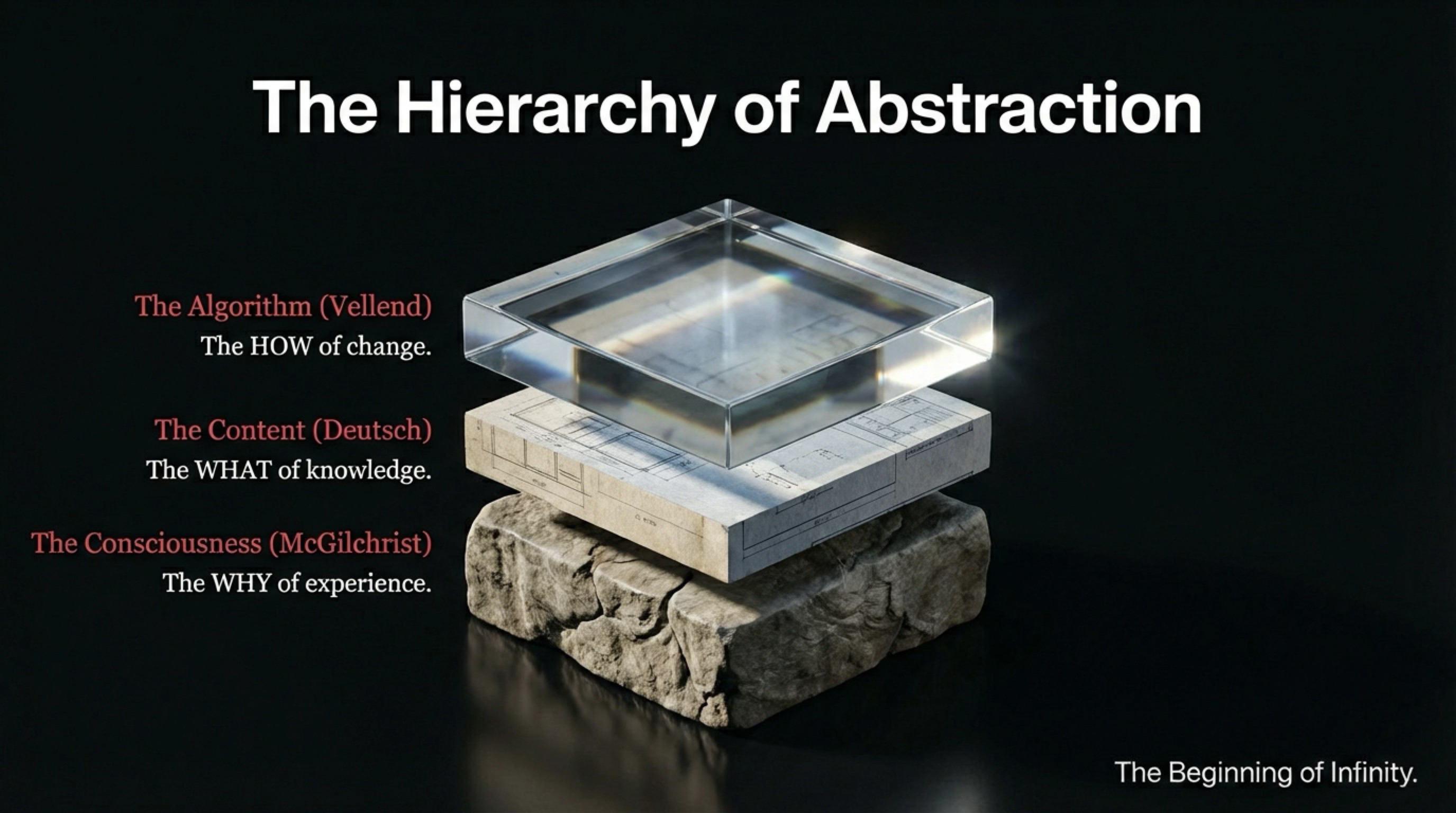
A Hierarchy of Abstraction: Algorithm, Content, and Consciousness
Rather than seeing these outlooks as mutually exclusive, we can arrange their frameworks into a complementary hierarchy, where each operates at a different but necessary level of abstraction.
- Vellend (The Algorithm): At the most abstract, content-free layer, Vellend provides the universal how of change—the basic algorithm of variation, selection, and inheritance that applies to any complex system.
- Deutsch (The Content): Deutsch populates this universal algorithm with its crucial human fuel. He specifies the crucial what for our species’ evolution: the creation and selection of knowledge in the form of good explanations.
- McGilchrist (The Consciousness): McGilchrist provides the grounding layer, addressing the experiential why of our current trajectory. He brings the analysis back to the embodied, psychological consciousness that wields these powerful intellectual tools, warning of the cognitive biases and pathologies inherent in our current path.
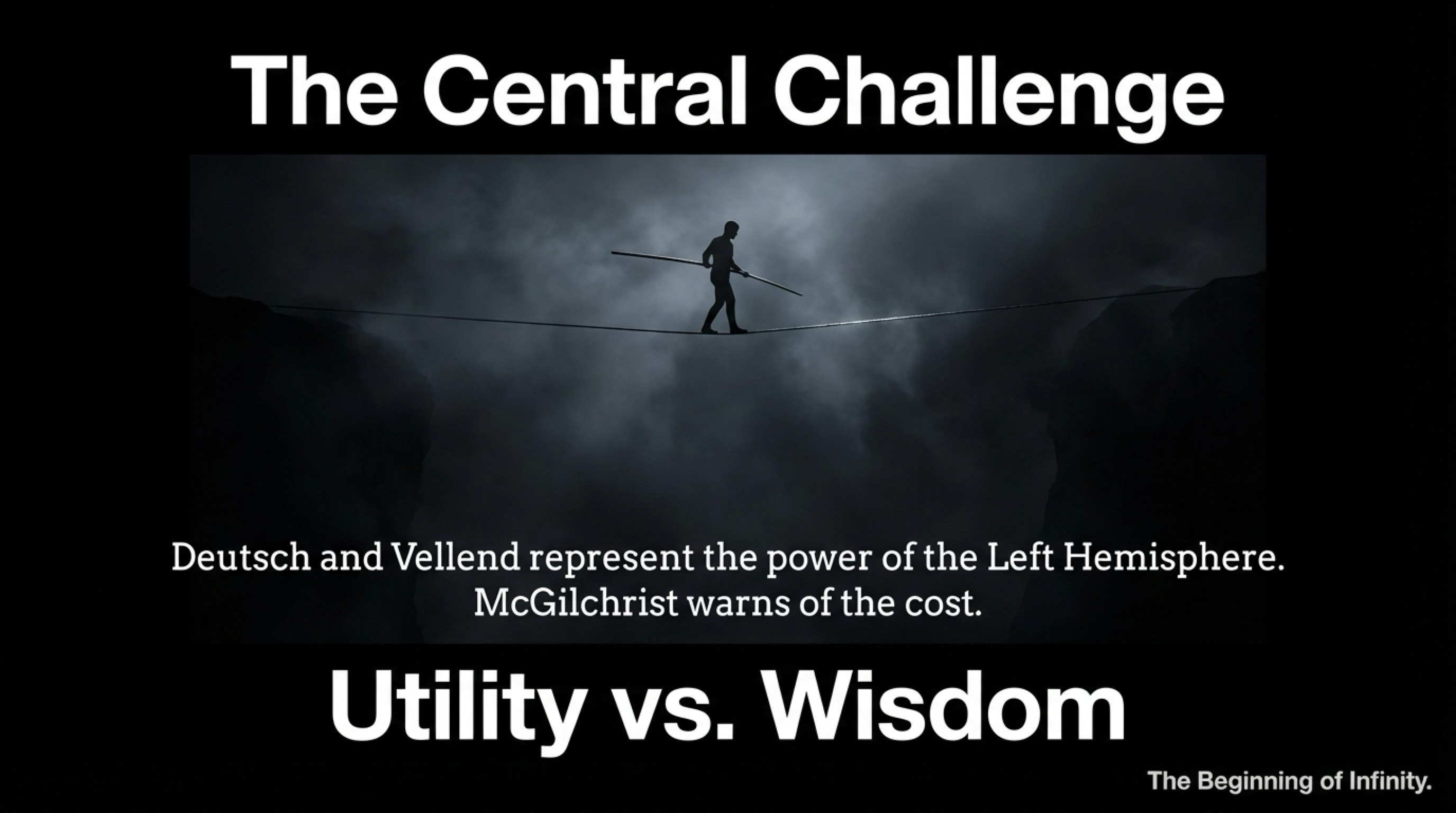
The Central Tension Between Utility and Wisdom
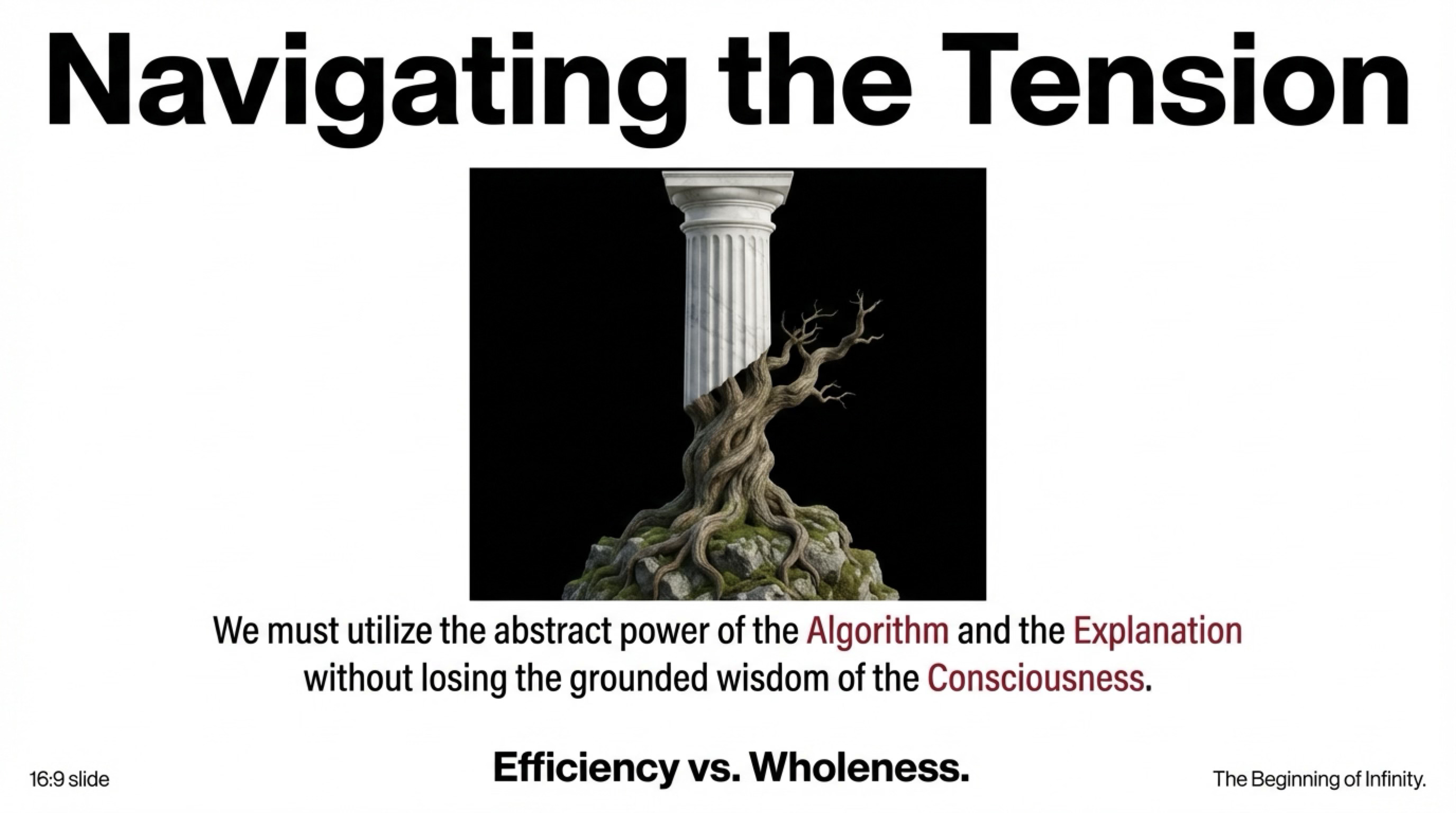
This synthesis reveals the crucial question for our era. The frameworks of Deutsch and Vellend exemplify the incredible power, efficiency, and problem-solving capacity of LH-driven systems. Yet, McGilchrist offers a stark warning that the unchecked dominance of this very cognitive style risks a civilisational delusion detached from the living world. The central challenge, therefore, is how to navigate the tension between the undeniable utility of these abstract systems and the existential risk inherent in their dominance. We are walking a tightrope stretched between Utility versus Wisdom and Efficiency versus Wholeness.
Sources:
David Deutsch, 2011, The Beginning of Infinity: Explanations that Transform the World. New York, New York: VIKING (Published by the Penguin Group).
Iain McGilchrist, 2019, The Master and His Emissary: The Divided Brain and the Making of the Western World. New Expanded Edition. New Haven and London: YALE UNIVERSITY PRESS.
—, 2021, The Matter With Things: Our Brains, Our Delusions and the Unmaking of the World. London: Perspectiva Press.
Mark Vellend, 2025, Everything Evolves: Why Evolution Explains More Than We Think, From Proteins to Politics. Princeton, New Jersey: Princeton University Press.


