A Mirror Shattered
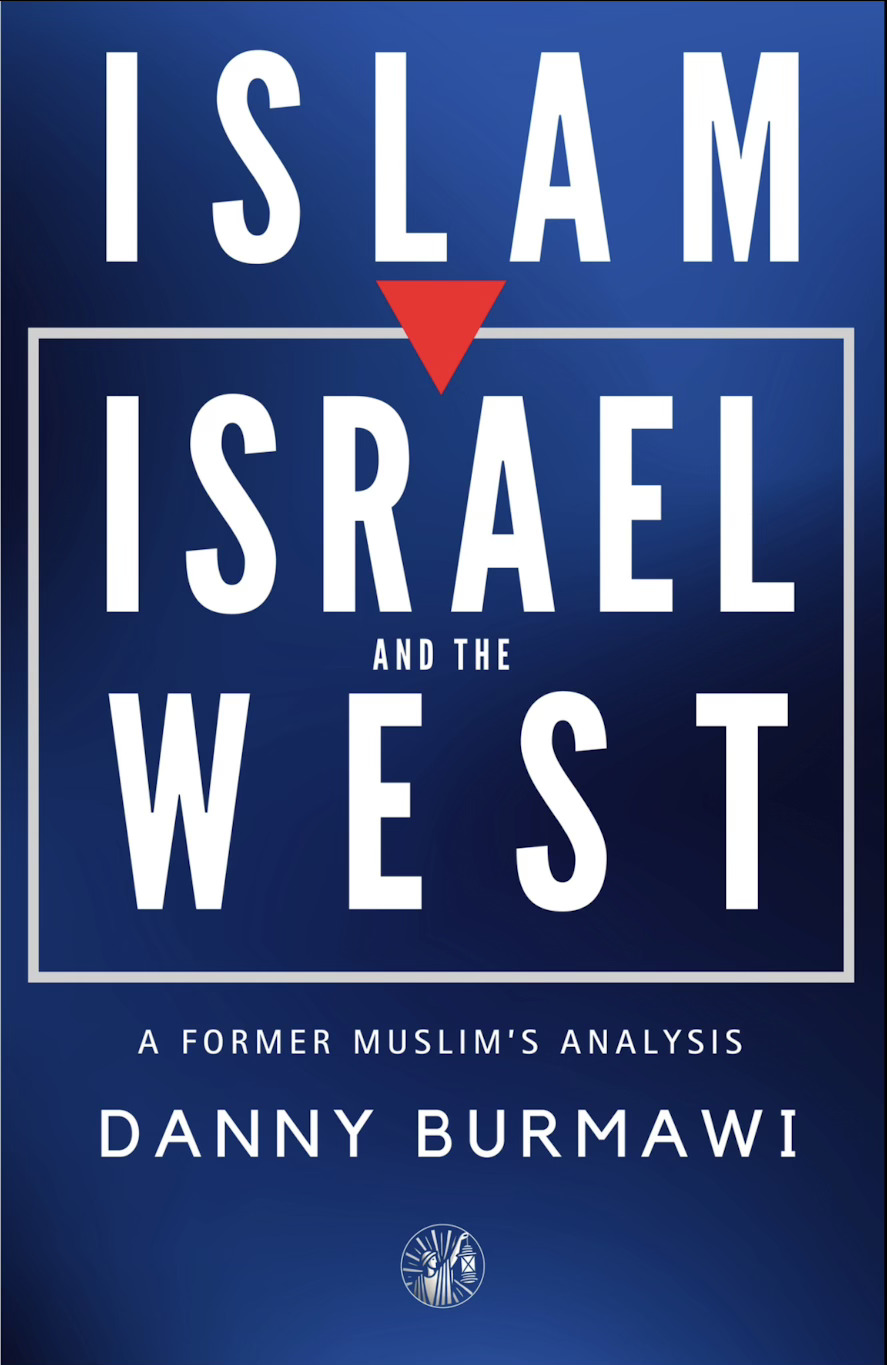
Danny Burmawi’s Islam, Israel and the West: A Former Muslim’s Analysis
By Khaled Salih
It begins on a cold New Year’s Eve in Chicago. Danny Burmawi, a former muslim [see note below], finds himself surrounded by fifteen thousand protesters on Michigan Avenue. Feminists, BLM activists, LGBT marchers, and Jewish youth in keffiyehs all chant the same slogan: “From the river to the sea, Palestine will be free.” When Burmawi asks one of them what it means, rage explodes. Within seconds, a mob forms. As police pull him away, his wife clutches their infant, an image that captures the essence of his book: the ideological war of the Middle East has already come West.
Moments earlier in life, he recalls, a Jewish woman had fled a park bench at the sound of his Arabic. The ironies are endless. The very conflict he escaped had followed him across the ocean, remade in Western slogans but stripped of its truth. In five surprising truths about islām, Israel, and the West, Burmawi sets out to expose those truths, ones learned from two decades inside the muslim world. Each revelation dismantles a comfortable illusion.
Never About the Palestinian People
Burmawi’s first claim is the most unsettling: the Palestinian cause, he says, has long been a façade. Arab leaders from Nasser to Saddam wrapped themselves in its flag, yet treated real Palestinians with cruelty and indifference. In Jordan, Lebanon, and Syria, Burmawi witnessed refugee camps deliberately frozen in squalor, places like Gaza Camp or Yarmouk, where Palestinians were denied jobs, property, and dignity.
Their suffering, he argues, was weaponised. The “Palestinian cause” served as a theological and political instrument to unify the Arab world against a shared enemy, not to uplift a people. Once you see that distinction, the entire moral architecture of the cause begins to crumble. If it was never about the Palestinians, then what was it really about?
It’s a Religious War
To Western ears, the Arab-Israeli conflict sounds like a dispute over land. To Burmawi, it is nothing of the sort. As a teenager in Jordan, he joined anti-Israel marches not because he cared about Palestinians but because he was a muslim. His awakening came not through politics but through a sermon, imam Khalid al-Rashid’s fiery call for loyalty to the prophet muḥammad, even unto bloodshed.
That sermon fused faith and fury. The West became a cosmic enemy; Israel, its outpost. “Marching,” he recalls, “became an act of worship.” This, he says, is how millions across the muslim world understand the conflict, not as geopolitics but as theology. Israel represents not a nation but a blasphemy, a “theological threat.” Until the West grasps this, its diplomacy will remain blind.
A Firewall Protection
After 9/11, a new linguistic trick entered public discourse: islām was peaceful; islām-ism was the problem. Burmawi calls this the greatest Western self-deception of the century. By splitting one faith into two categories, academics and policymakers invented a moral loophole. They could denounce terror without confronting the theology that inspires it.
More than 64,000 terrorist attacks have been carried out in islām’s name since 2001, yet the faith itself remains shielded from scrutiny. In the West, Burmawi writes, we dissect every ideology, except this one. The result is that doctrines of jihād, supremacism, and intolerance continue unchallenged, thriving under the cover of linguistic respectability.
The Two-State Mirage
For decades, the two-state solution has been the sacred cow of diplomacy. Burmawi shatters it. The reason it always fails, he argues, is brutally simple: the conflict has never been about where Israel is, but whether it should exist at all.
The evidence is irrefutable. In 2000, Yasser Arafat rejected a near-total peace offer and launched the Second Intifada. In 2005, Israel withdrew entirely from Gaza, only for Hamas to seize it and turn it into a launchpad for terror. You cannot make peace, Burmawi insists, “by granting sovereignty to an ideology that calls for your annihilation.” The two-state formula offers a political solution to a theological war: a category error that guarantees endless bloodshed.
A Frozen Moral Ceiling
Burmawi’s most profound argument is civilisational. In islām, he writes, moral evolution is structurally impossible because its founder’s life is considered the eternal model. Every act, from child marriage to enslavement, is sanctified as divine precedent. To critique it is heresy.
This immovability stands in stark contrast to the moral dynamism of Judaism and Christianity, where prophets are flawed and the text reigns above the man. In islām, the man reigns above the text. “The text serves the man,” Burmawi writes, and that inversion locks the faith in a 7th-century moral universe. The result is a permanent tension between the values of islām and the liberal humanism of the West.
Beyond the Slogans
Burmawi’s Five Surprising Truths is more than a memoir or polemic, it is a mirror held to both worlds. To the West, he says: stop mistaking a theological war for a political grievance. To the muslim world, he says: your moral ceiling is self-imposed. And to both, it demands profound self-reflections over comfort.
The book’s great achievement lies in its courage. It forces readers to ask: what if the entire Western narrative of this conflict, of victims and occupiers, of peace processes and protests, is built on a distorted mirror? What if the problem is not land or policy but theology itself?
Burmawi does not offer easy answers. He offers something rarer: clarity. And in an age of slogans, that may be the most daring act of all.
Danny Burmawi, 2025, Islam, Israel and the West: A Former Muslim’s Analysis. Published in the United States of America, GERASA BOOKS
Note: There is no capital letter in the Arabic language, so all Arabic words are written as they would appear in any Arabic text. The “magic” used in Arabic to elevate the meaning of a word is to put an “al” in front of the word. For example, the verb root h-d-y can form hadā (to guide, lead to the right way). hādī means the one who guides and al-hādī means The Guide, which is also among allāh’s, as well as muḥammad’s, 99 names.


