A Memorandum on the Solvability of Human Problems
19 December 2025
This text is the first of two deeply connected essays born from an inquiry into the “architecture of ideas” and the cognitive machinery shaping our public discourse. Titled A Memorandum on the Solvability of Human Problems, it serves as the strategic “first pillar,” identifying the rise of anti-rational memes as the primary threat to our problem-solving capacity and proposing a philosophy of rational optimism as the necessary antidote.
It forms a coherent project with the forthcoming second essay, The Two Worlds: A Unified Framework for Analysing Ideas. While the Memorandum diagnoses the civilization-level symptoms of stagnation, The Two Worlds acts as the “master key” and “analytical compass,” revealing that these threats are manifestations of a deeper cognitive imbalance between the “Master” and “Emissary” worldviews.
The Premise of Optimism
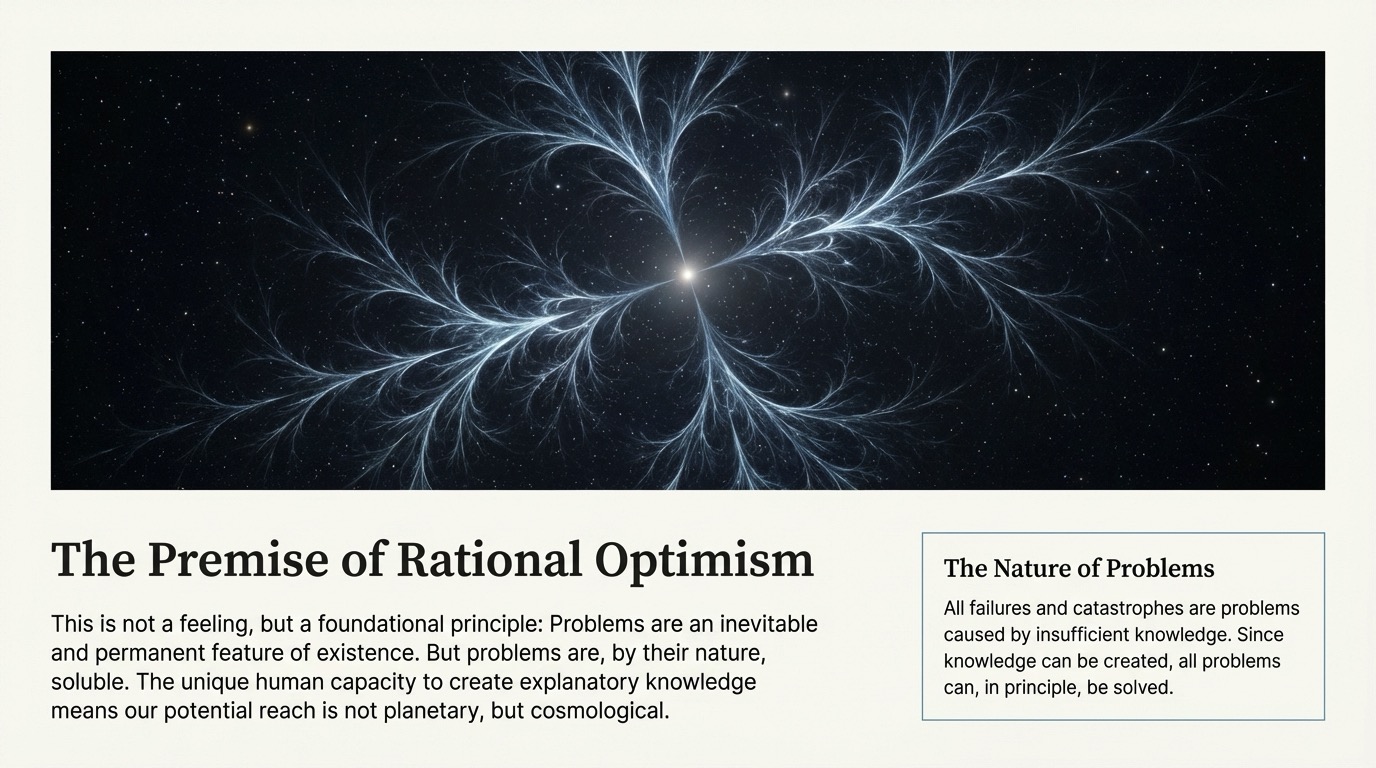
Imagine you request counsel on the challenges facing humanity. Any meaningful advice on this matter must be grounded in a correct understanding of the nature of problems and knowledge. It must begin not with a feeling, but with a foundational philosophical principle: optimism.
This is not the optimism of blind hope. It is a specific, rational assertion, as the physicist David Deutsch says:
All evils are caused by insufficient knowledge.
Problems are an inevitable and permanent feature of existence. This is not a cause for despair, because problems are, by their nature, soluble. The unique human capacity to create new, explanatory knowledge means that our potential reach is not planetary, but cosmological, bounded only by the laws of physics themselves.
As Deutsch states,
“everything that is not forbidden by laws of nature is achievable, given the right knowledge.”
Let us, therefore, identify the single most significant challenge facing our civilisation: not any particular external threat, but the corruption of the very systems by which we solve problems. And, then, outline a rational strategy, grounded in a correct epistemology, for ensuring the continuation of progress—a journey that is the beginning of infinity.
Identifying the Fundamental Challenge to Humanity
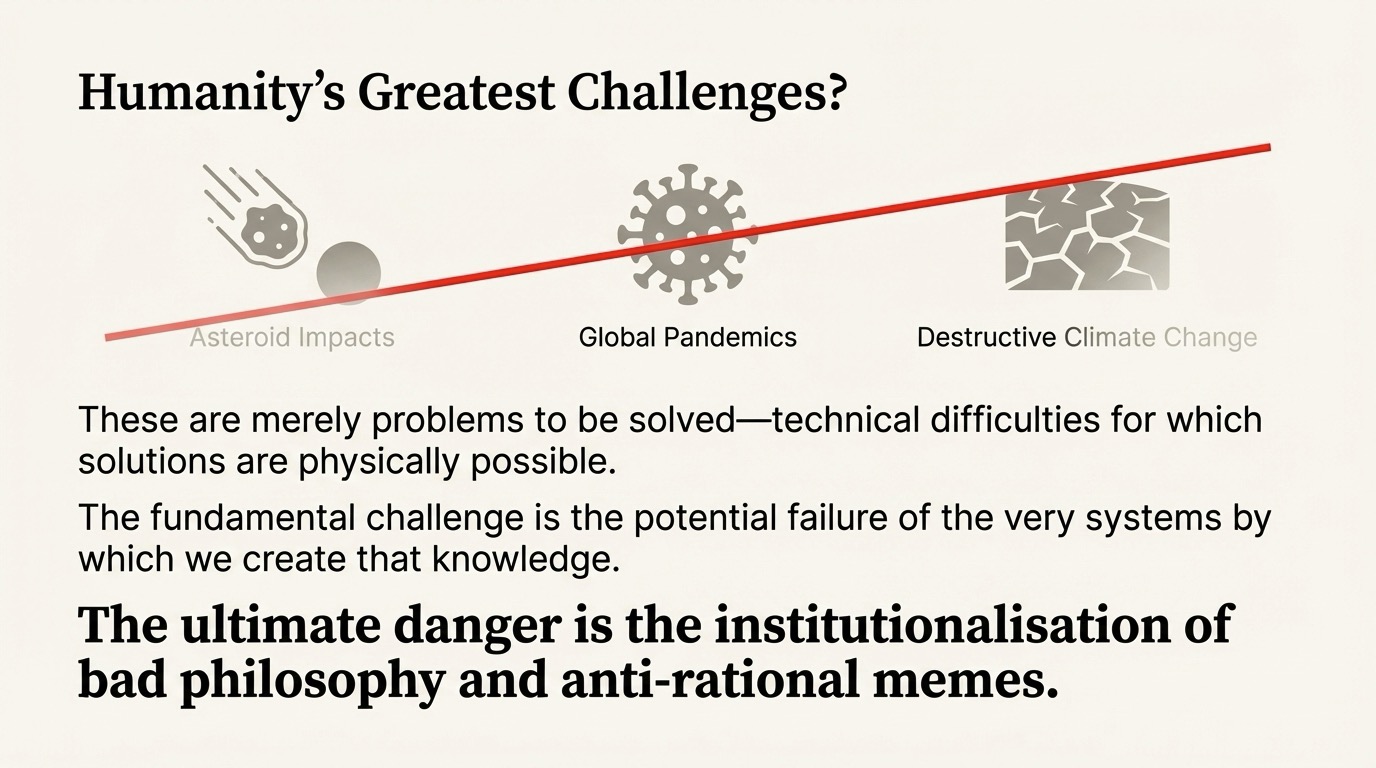
Humanity’s greatest challenges are systematically misidentified. Threats such as asteroid impacts, pandemics, or destructive climate change are serious, yet they are merely problems to be solved—technical difficulties for which solutions are physically possible, given the right knowledge. The true, fundamental challenge is the potential failure of the very systems by which we create that knowledge. The ultimate danger is not that we will encounter an insoluble problem, but that we will render ourselves incapable of solving soluble ones.
This fundamental challenge is:
the rise and institutionalisation of bad philosophy and anti-rational memes that inhibit or forbid the creation of knowledge.
These are ideas that, by design or consequence, attack the foundations of progress. To understand this threat, we must contrast two types of societies:
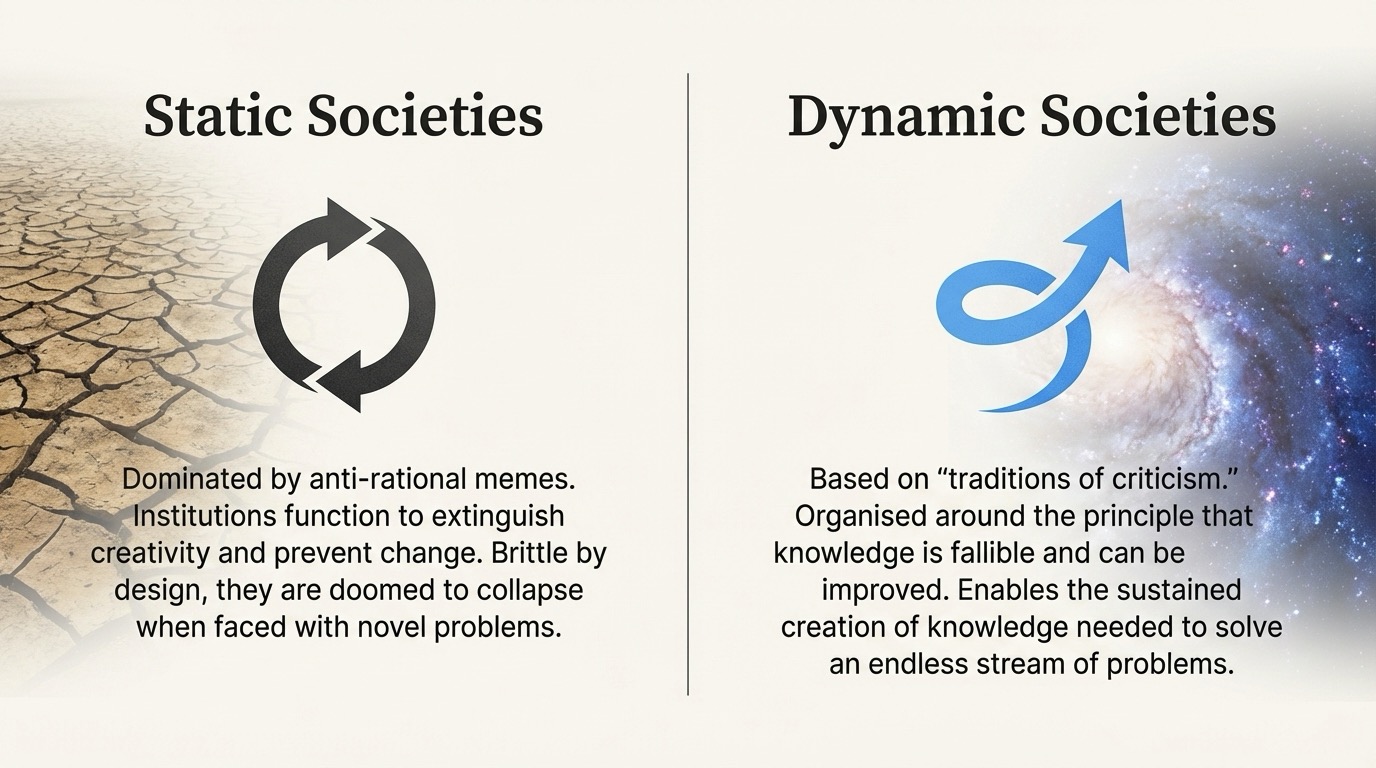
- Static Societies: These cultures, which represent the vast majority of human history, are dominated by anti-rational memes. Their traditions and institutions function “to extinguish their members’ creativity and break their spirits” in the name of stability. The primary purpose of such a society is to prevent change and suppress criticism. By forbidding the error-correction necessary for progress, they become inherently brittle. When faced with a novel problem for which their traditional knowledge is insufficient—a climate shift, a new disease, a resource shortage—they are doomed to collapse.
- Dynamic Societies: These cultures are based on “traditions of criticism” and the optimistic pursuit of problem-solving. They are organised around the principle that existing knowledge is fallible and can be improved. The Enlightenment marked the beginning of our uniquely long-lived dynamic society, which, for the first time in history, enabled the “sustained and accelerating creation of knowledge.” It is this capacity, and this alone, that allows a civilisation to solve the endless stream of problems it will inevitably face.
The ultimate danger to our civilisation is not any specific external threat, but the risk of reverting to the fragility of a static society. This happens when we adopt philosophies that cripple our unique, error-correcting, knowledge-creating abilities. These dangerous, anti-rational philosophies manifest in several distinct, high-priority threats that must be understood and countered.
The Corrupting Influence of Bad Philosophy
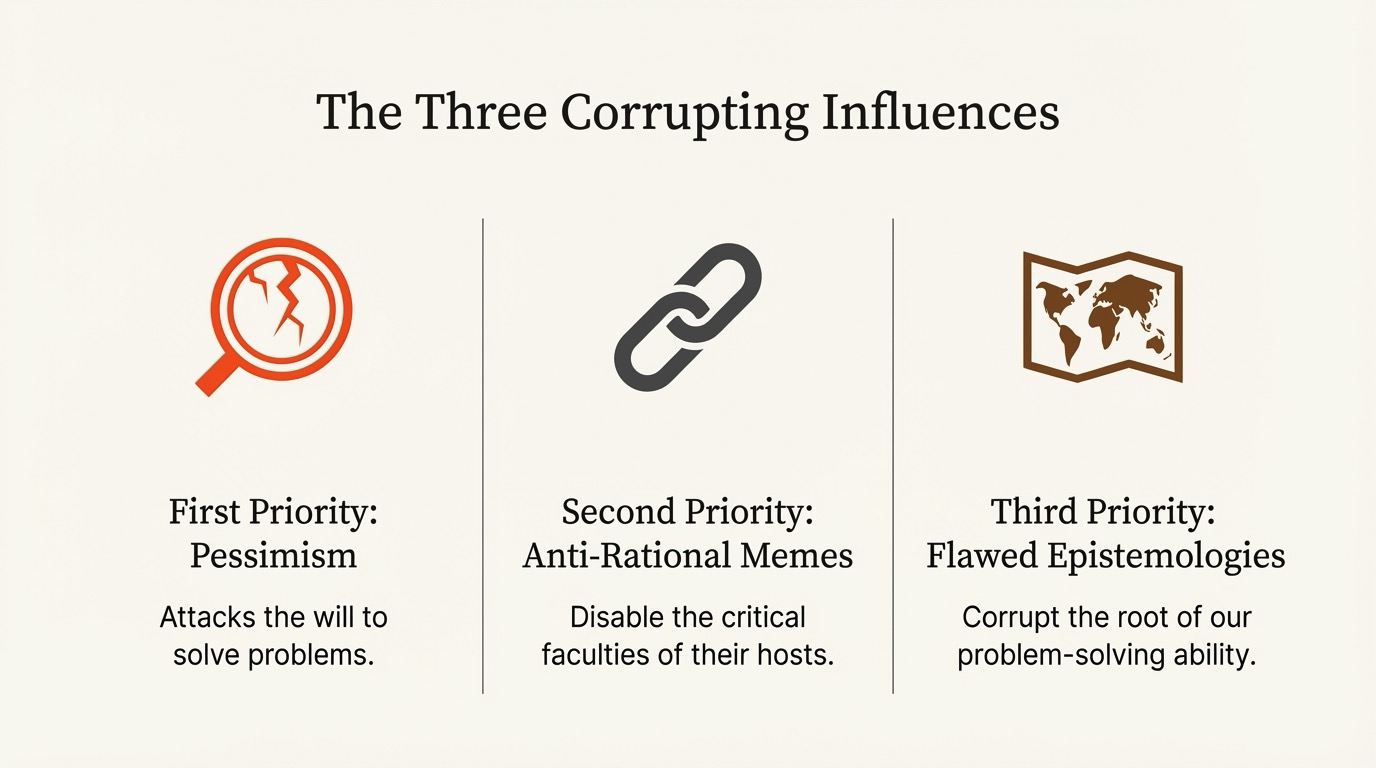
To combat the fundamental challenge to progress, we must dissect its most dangerous manifestations. The reversion to a static society is not an abstract risk; it is advanced by specific philosophical errors and anti-rational memeplexes that are active today. Let us analyse these threats in order of priority, based on their potential to corrupt our capacity for problem-solving.
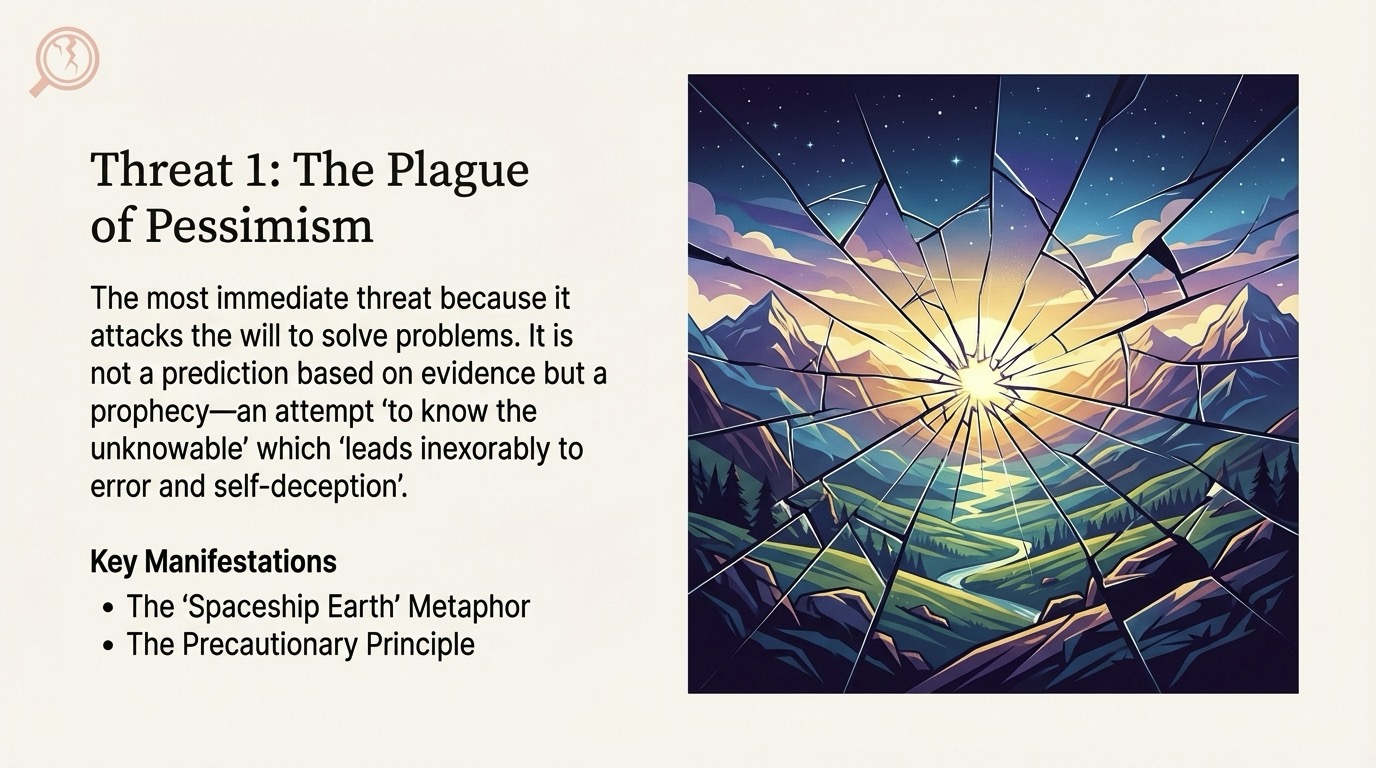
First Priority: The Plague of Pessimism
- Philosophical Pessimism is the most immediate threat because it attacks the will to solve problems. It is not a prediction based on evidence but a prophecy—an attempt “to know the unknowable” which “leads inexorably to error and self-deception.” It manifests in several influential and damaging concepts:
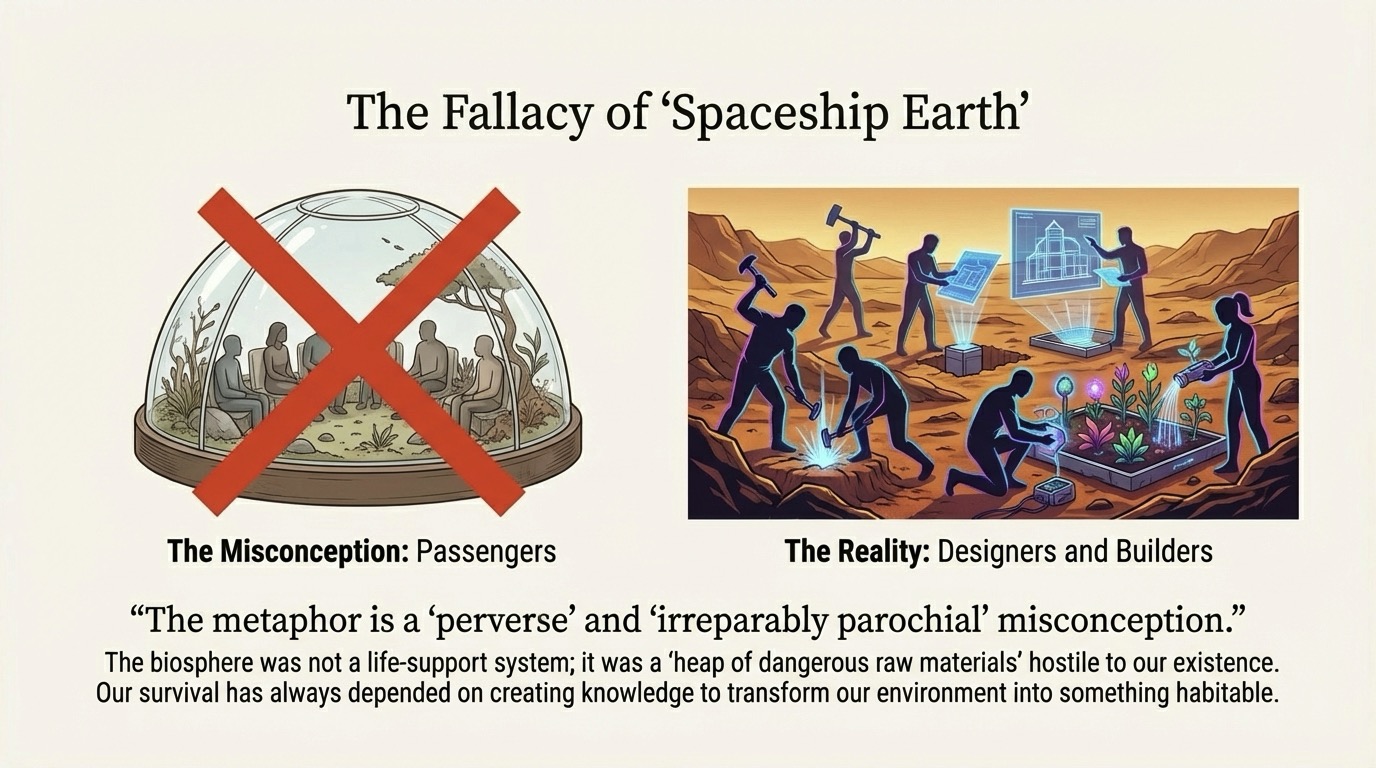
- The “Spaceship Earth” Metaphor. This idea frames humanity as mere “passengers” on a fragile planet with a finite life-support system. This is a “perverse” and “irreparably parochial” misconception. The biosphere is not a life-support system; before human knowledge transformed it, it was a “heap of dangerous raw materials” hostile to biological, including human, existence. We are not its passengers; we are its “designers and builders.” Our survival has always depended on creating knowledge to transform our environment into something habitable, a process limited only by physical law, not by the initial state of the planet.
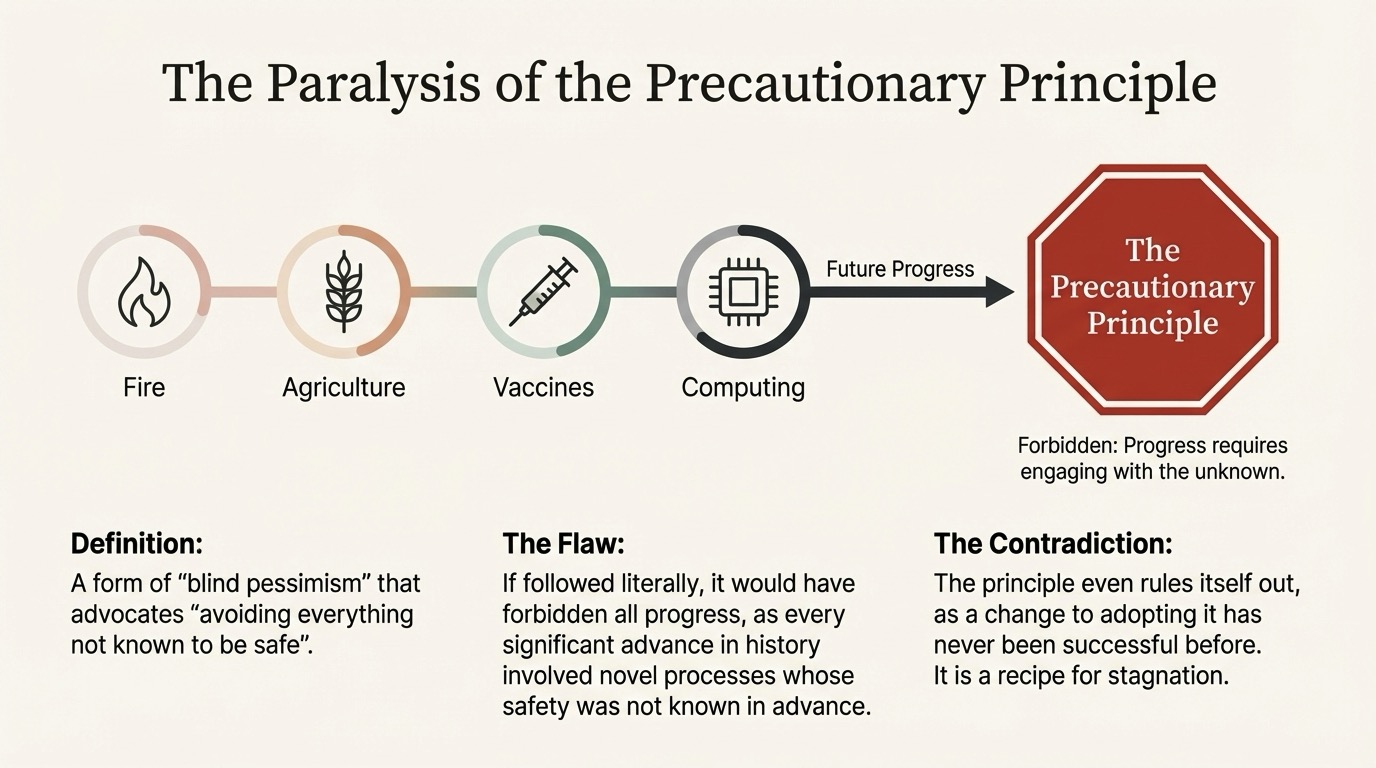
- The Precautionary Principle. This principle is a form of “blind pessimism” that advocates “avoiding everything not known to be safe.” If followed literally, it would have forbidden all progress, as every significant advance in history—from the control of fire to the development of vaccines—involved novel processes whose safety was not known in advance. The principle even rules itself out, as a change to adopting it has never been successful before. It is a recipe for stagnation and, therefore, eventual collapse.
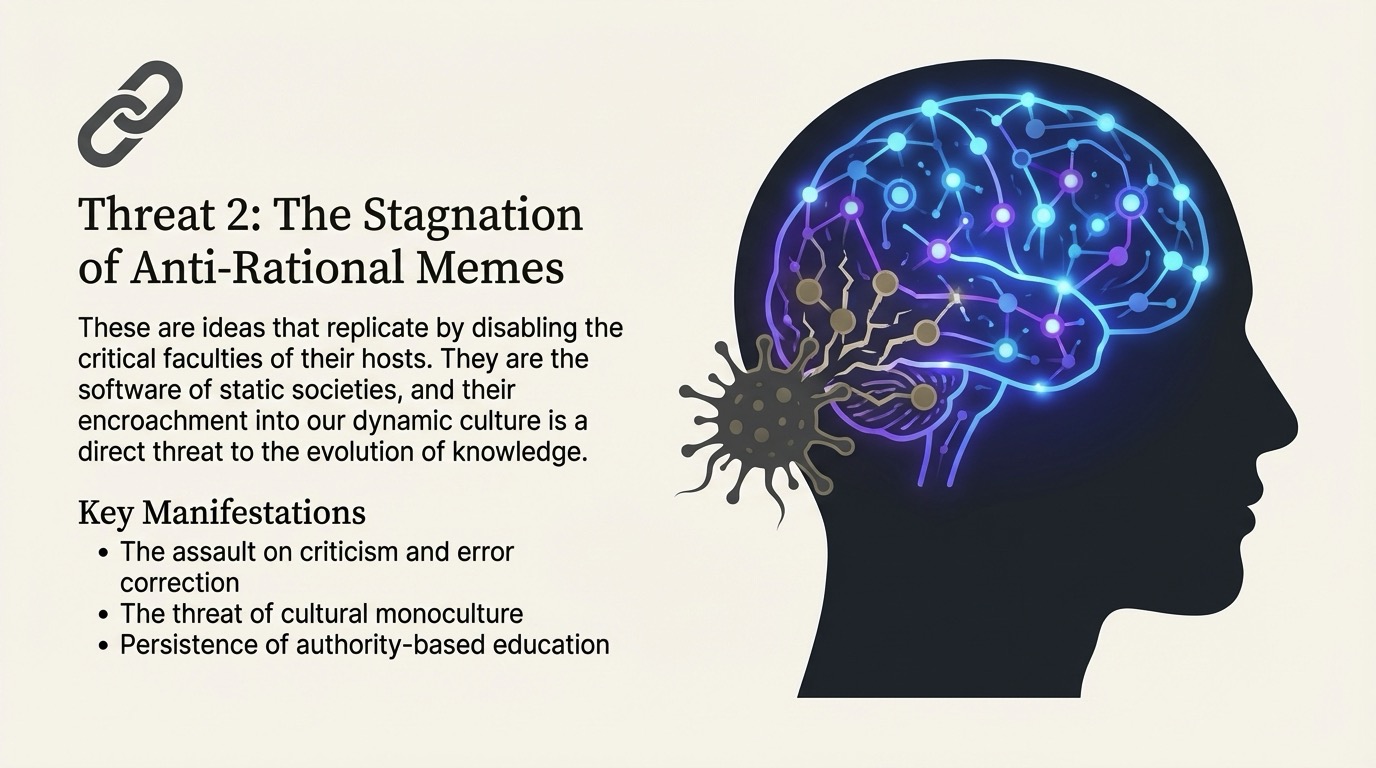
Second Priority: The Stagnation of Anti-Rational Memes
The Danger of Anti-Rational Memeplexes are that these ideas replicate by disabling the critical faculties of their hosts. They are the software of static societies, and their encroachment into our dynamic culture is a direct threat to the evolution of knowledge.
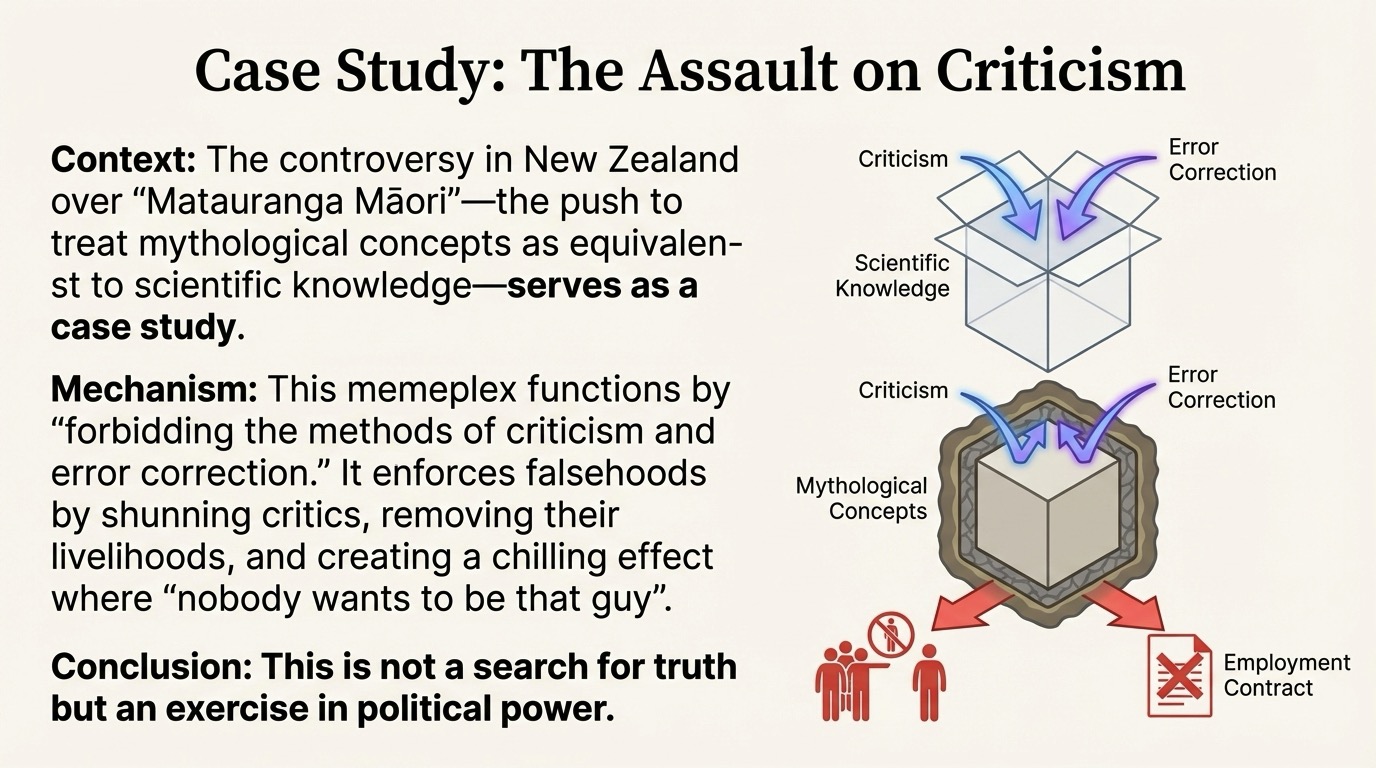
Mechanism of Modern Anti-Rationality. These systems gain political power by directly assaulting the foundations of a dynamic society. The controversy in New Zealand over “Matauranga Māori”—the push to treat mythological concepts as equivalent to scientific knowledge—serves as a case study. This memeplex functions by “forbidding the methods of criticism and error correction.” It enforces falsehoods by shunning critics, removing their livelihoods, and creating a chilling effect where “nobody wants to be that guy.” This is not a search for truth but an exercise in political power designed to entrench authority.
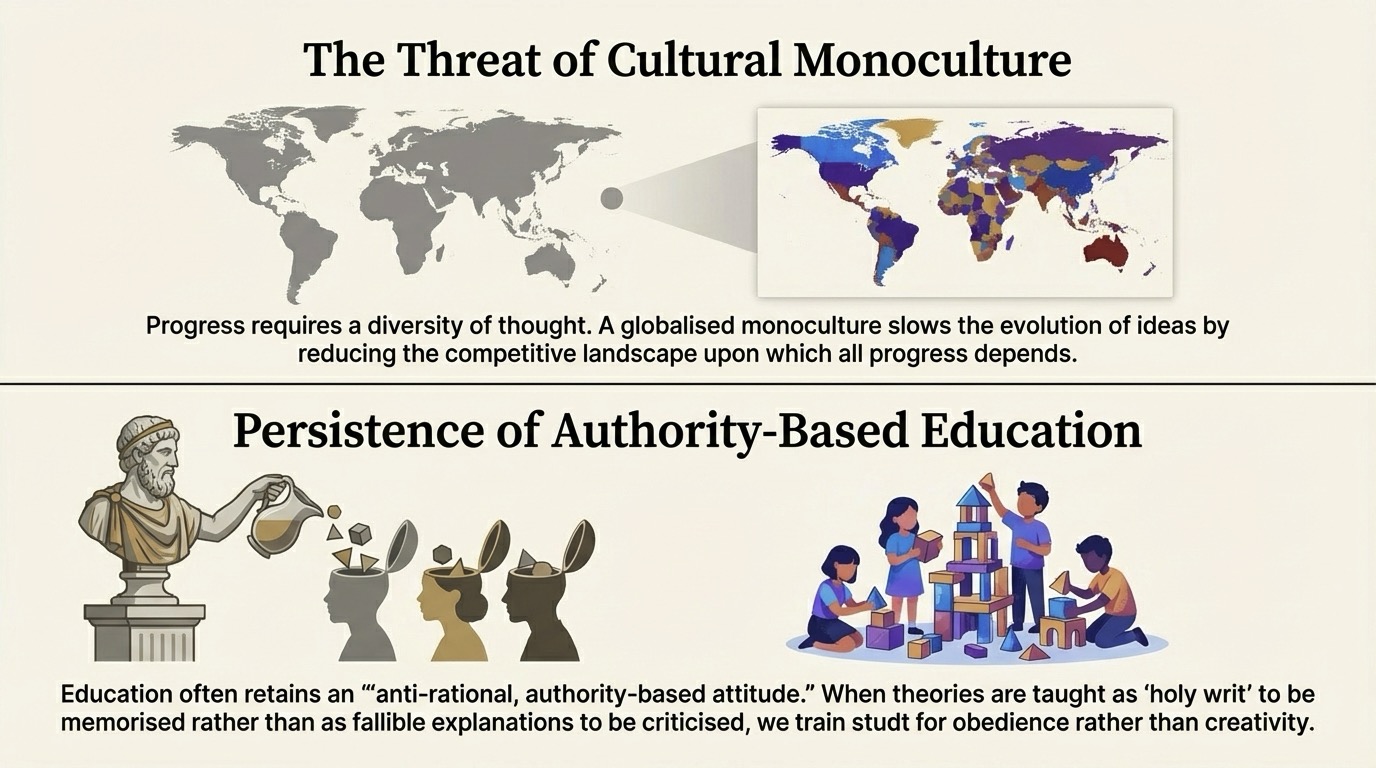
Threat of Cultural Monoculture. Progress requires a diversity of thought. Analogous to species evolution, a globalised world with only a few large, integrated cultures will be worse at generating the novel ideas needed to solve future problems. A global monoculture, even if internally efficient, slows the evolution of its core shared features by reducing the competitive landscape of ideas upon which all progress depends.
Persistence of Authority-Based Education. Education is one of the last domains to be fully touched by the Enlightenment, retaining an “anti-rational, authority-based attitude to knowledge.” When established theories like Newton’s laws are taught as “holy writ”—as facts to be memorised rather than as fallible explanations to be understood and criticised—we train students for obedience rather than creativity. This closes off “paths to progress” by teaching the answers of the past rather than the methods for solving the problems of the future.
Third Priority: The Parochialism of Flawed Epistemologies
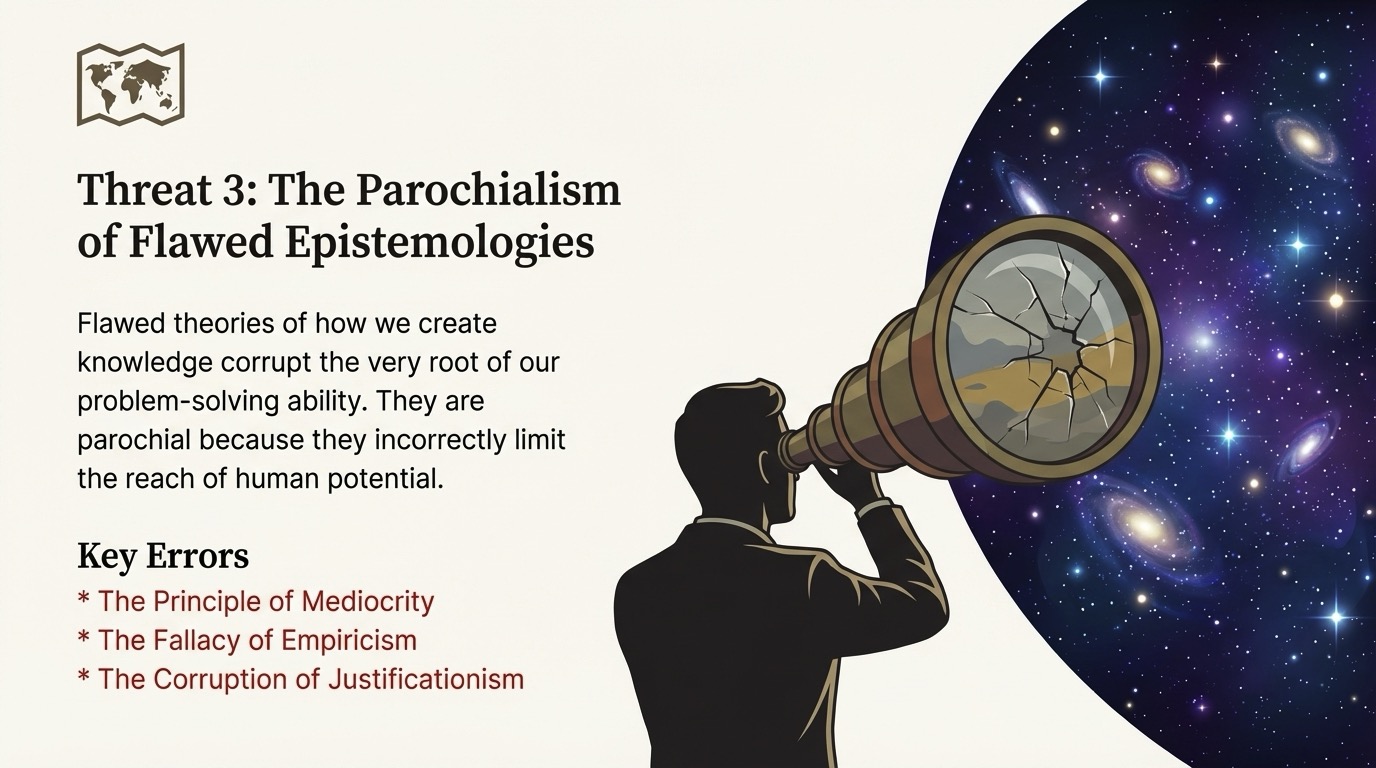
The Error of Bad Epistemologies as flawed theories of how we create knowledge corrupt the very root of our problem-solving ability. They are parochial because they incorrectly limit the reach of human potential.
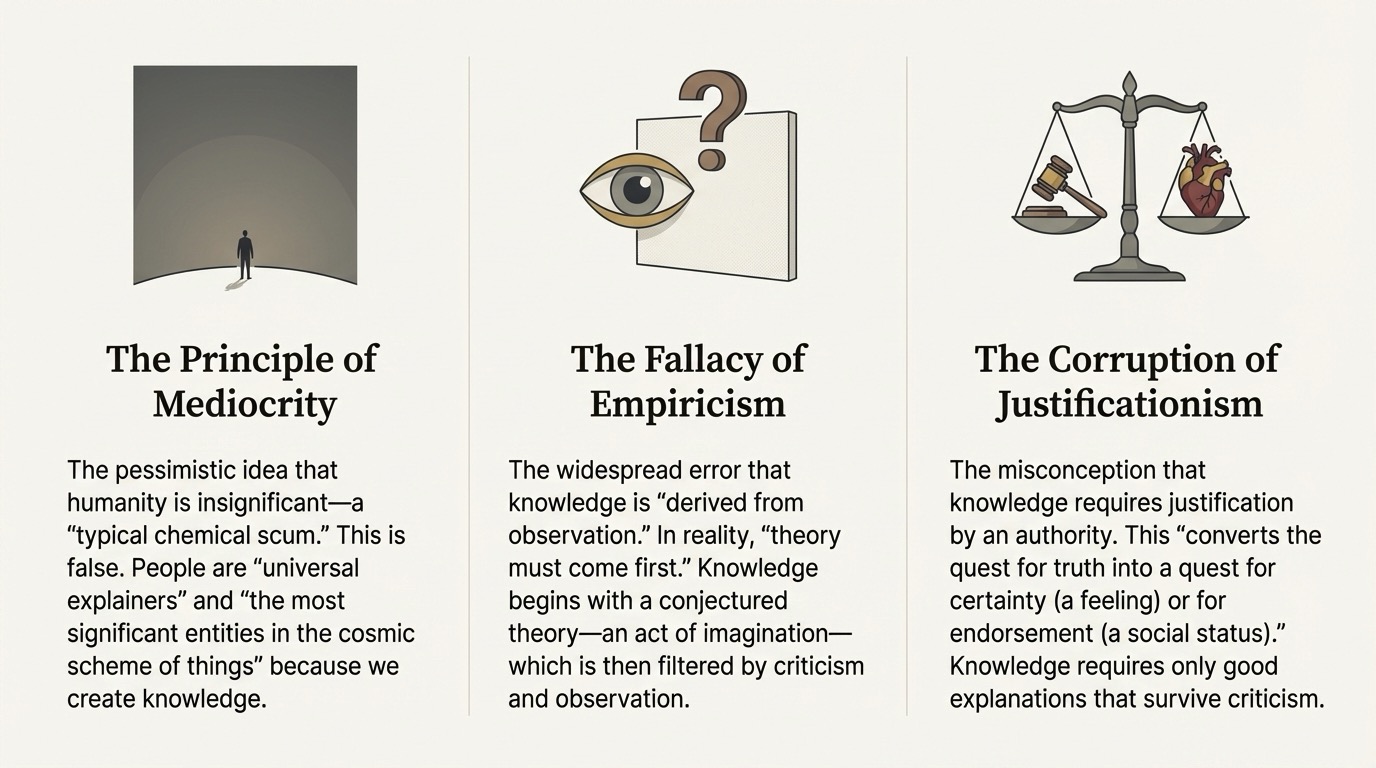
The Principle of Mediocrity. This is the pessimistic idea that humanity is insignificant—a “typical chemical scum”—and that our capacity to understand is inherently limited by our biology. This is false. By virtue of our ability to create explanatory knowledge, people are “universal explainers” and “the most significant entities in the cosmic scheme of things.” Knowledge has the power to transform the universe, and we are the entities that create it.
The Fallacy of Empiricism. This is the fundamental and widespread error that knowledge is “derived from observation.” All knowledge creation begins with a problem and a conjectured theory—an act of imagination. As Karl Popper argued, and Deutsch reiterates, “theory must come first.” That theory is then subjected to criticism, which includes testing against observation. Observation does not generate theories; it filters them.
The Corruption of Justificationism. This is the ancient misconception that knowledge must be justified by an authority, lately aslo as sensory experience. This is a destructive fallacy that “converts the quest for truth into a quest for certainty (a feeling) or for endorsement (a social status).” Knowledge does not require justification; it requires good explanations that survive criticism.
Having identified these corrosive threats to our knowledge-creating systems, the logical next step is to formulate a robust strategy grounded in a correct, optimistic epistemology.
A Strategy for the Beginning of Infinity
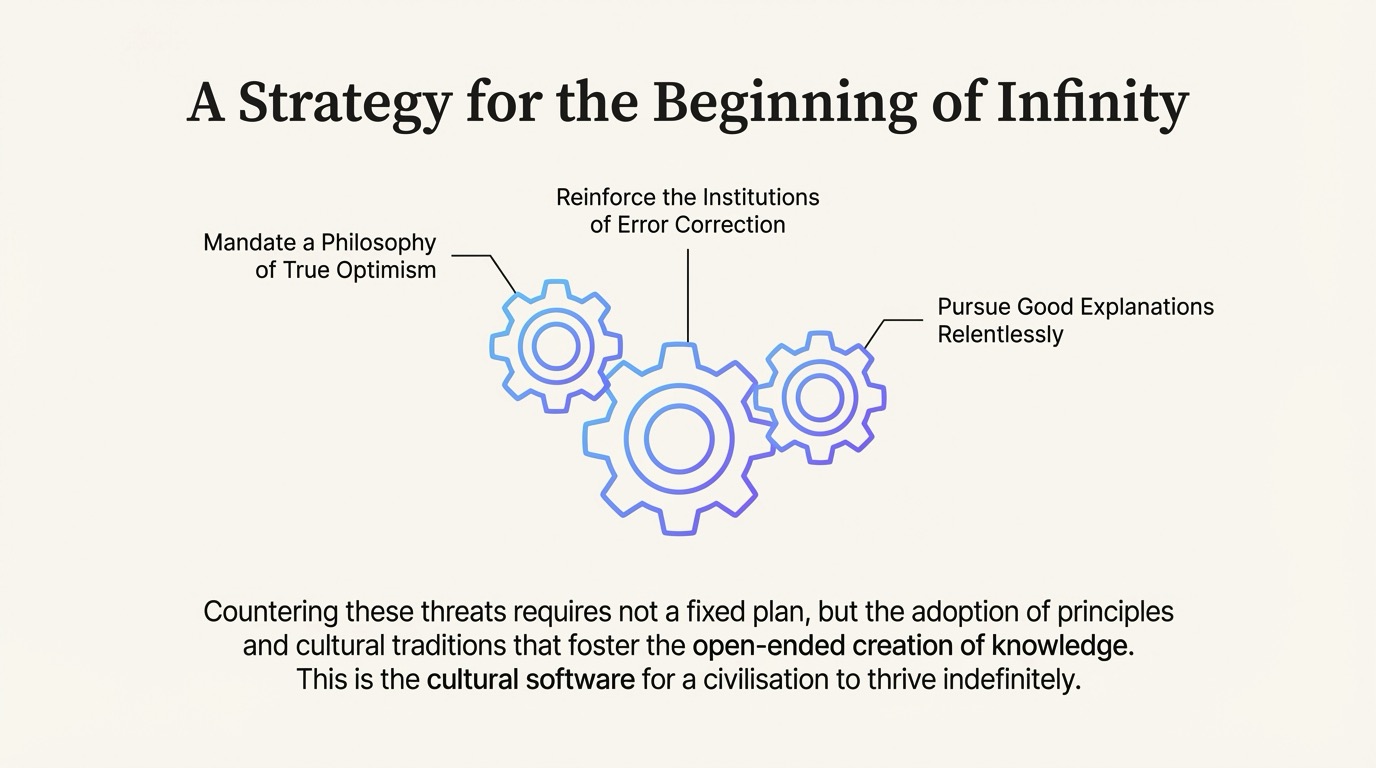
Countering these threats requires not a fixed plan, but the adoption of principles and cultural traditions that foster the open-ended creation of knowledge. This strategy provides the cultural software necessary for a civilisation to thrive indefinitely.
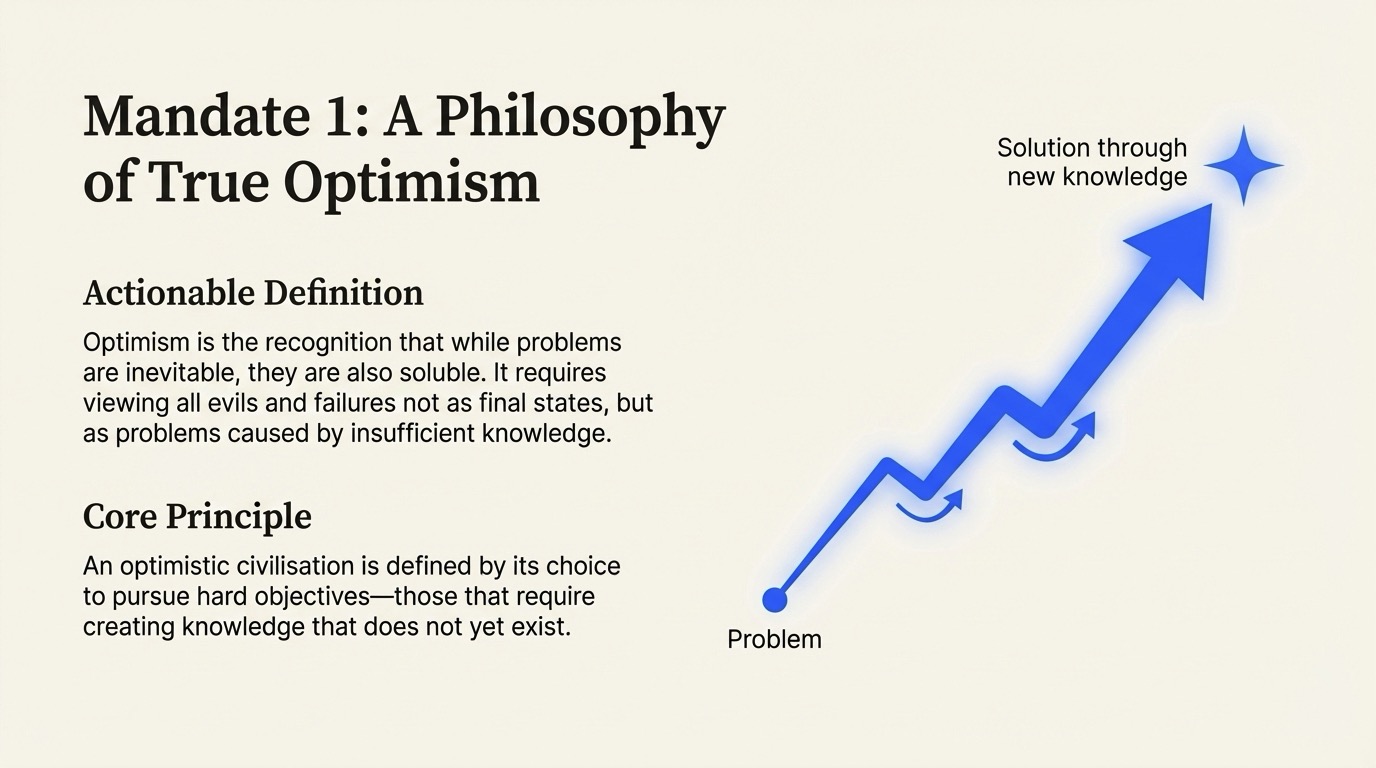
Mandate a Philosophy of True Optimism
- Actionable Definition of Optimism. Optimism is defined as the recognition that while problems are inevitable, they are also soluble. This requires viewing all evils, failures, and catastrophes not as punishments or final states, but as problems caused by insufficient knowledge. Since knowledge can be created, these problems can, in principle, be solved. This stance is the direct antidote to the plague of pessimism.
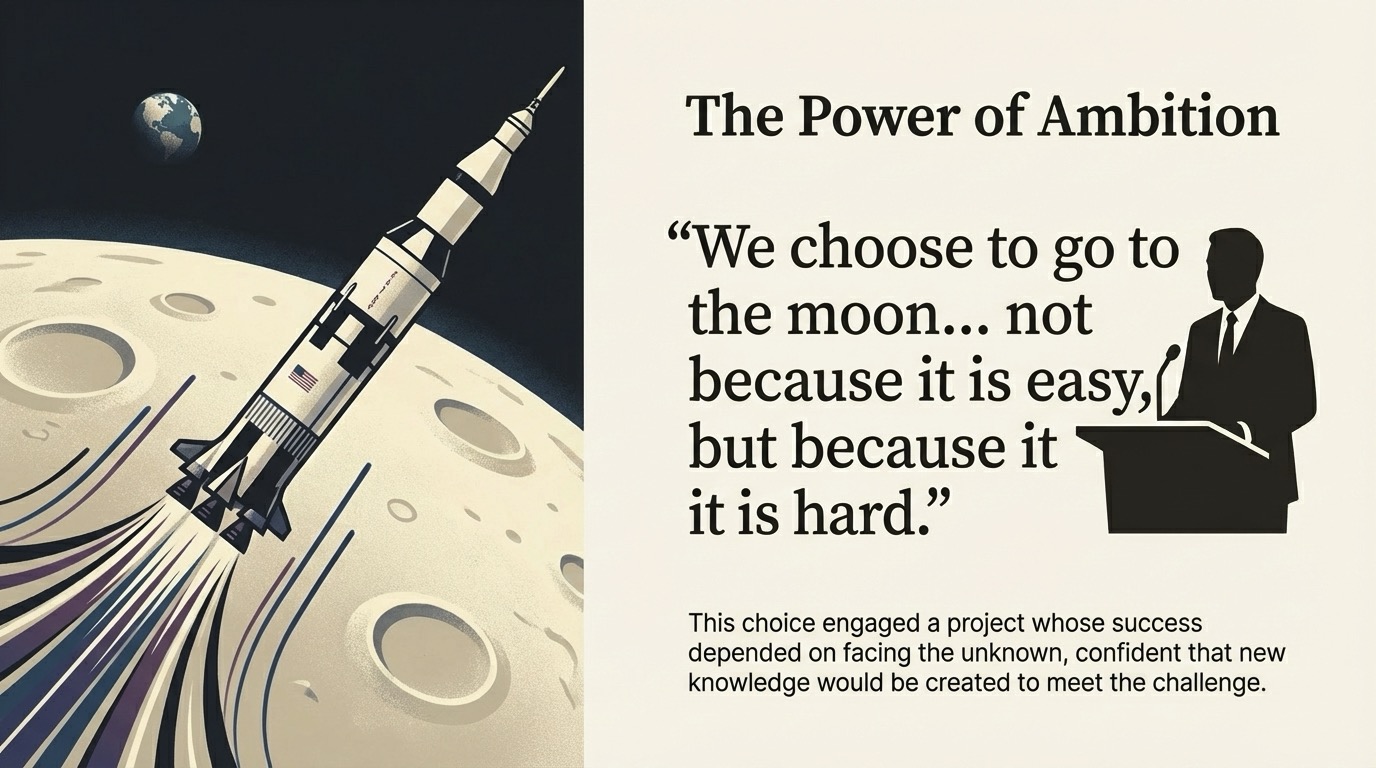
- Pursuit of Ambitious Objectives. An optimistic civilisation is defined by its choice to pursue hard objectives—those that require creating knowledge that does not yet exist. President John F. Kennedy’s 1962 declaration that America would go to the moon “not because [it is] easy, but because [it is] hard” illustrates this principle. He chose to engage with a project whose success depended on facing the unknown and solving problems, confident that new knowledge would be created to meet the challenge.
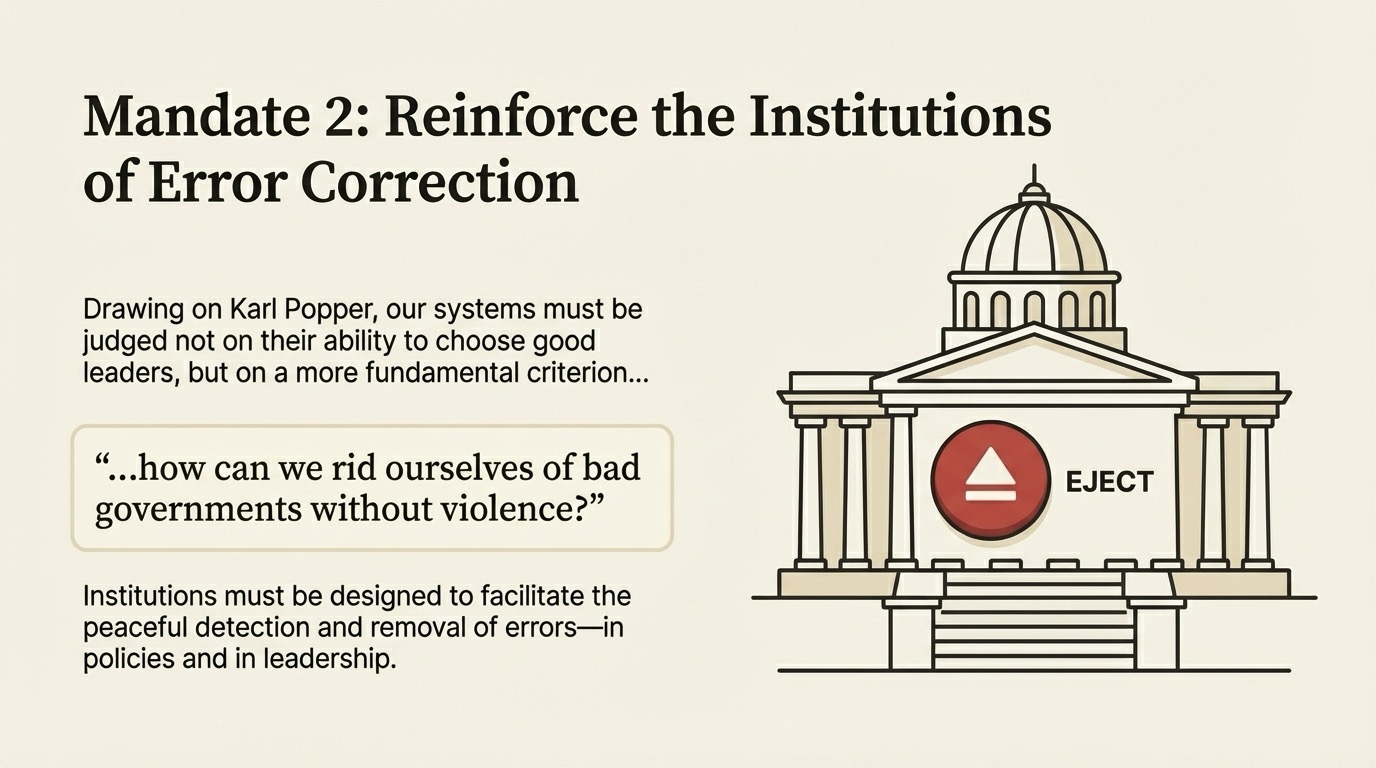
Reinforce the Institutions of Error Correction
- The Prime Directive for Institutions. Drawing on the philosophy of Karl Popper, our political and social systems must be judged not on their ability to choose good leaders, but on a more fundamental criterion: “how can we rid ourselves of bad governments without violence?” Institutions must be designed to facilitate the peaceful detection and removal of errors—in policies and in leadership.
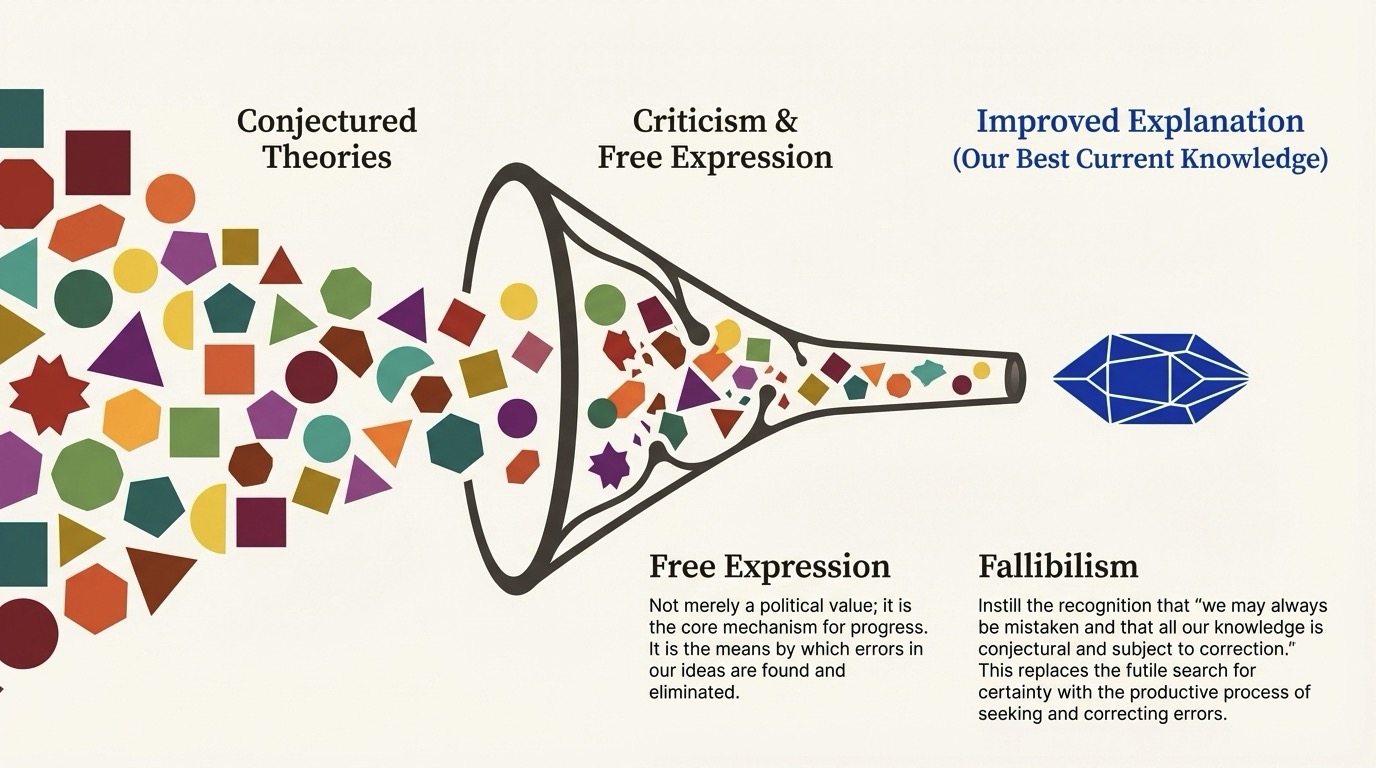
- The Paramountcy of Free Expression. Open criticism and free speech are not merely political values; they are the core mechanisms for progress. They are “essential... to progress and to our long-term well-being” because they are the means by which errors in our ideas are found and eliminated. Any ideology that seeks to suppress speech or shun critics is a direct threat to our civilisation’s survival and a tool of anti-rational memeplexes.
- Instill a Culture of Fallibilism. Instill the recognition that “we may always be mistaken and that all our knowledge is conjectural and subject to correction.” This attitude is a prerequisite for progress. It replaces the futile search for certainty with the productive process of seeking out and correcting errors in our current best explanations.
Pursue Good Explanations Relentlessly
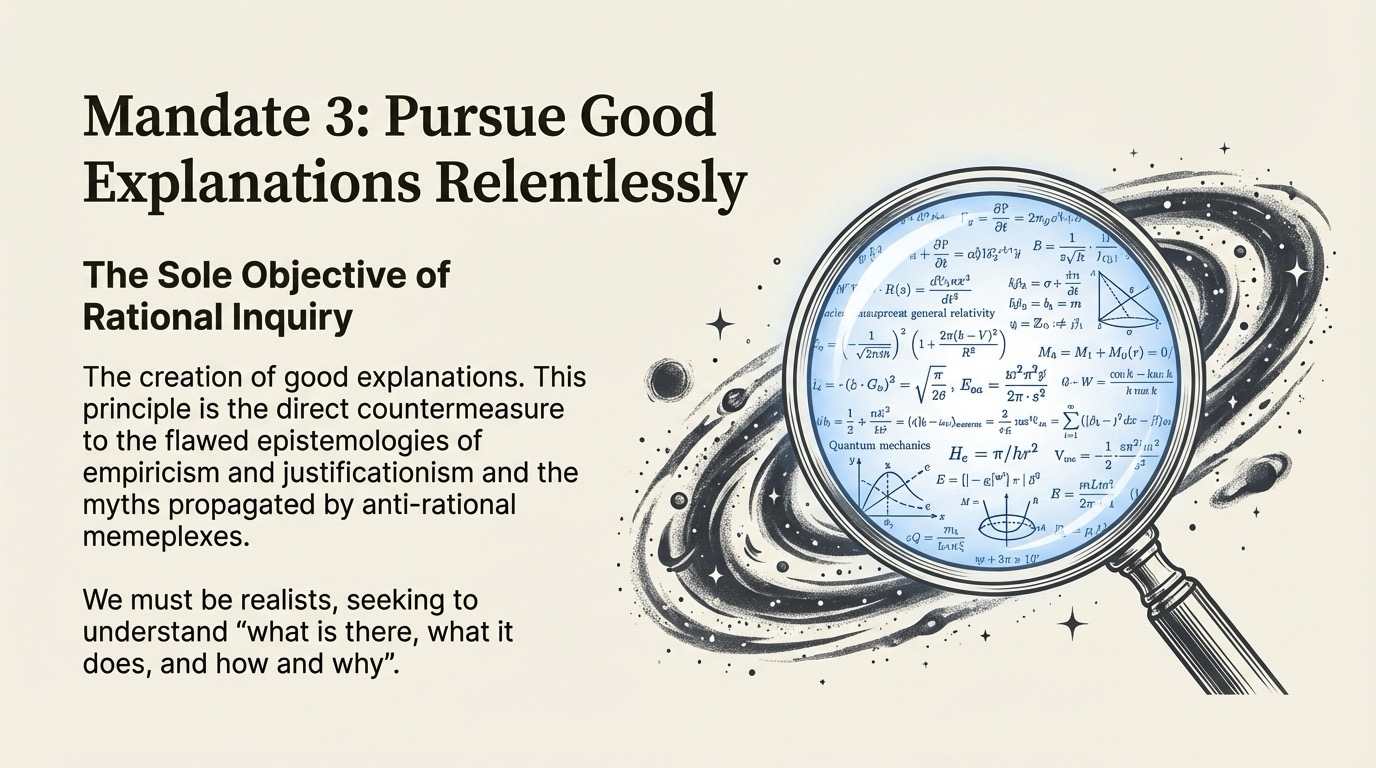
- The Sole Objective of Rational Inquiry. The sole objective of all rational inquiry is the creation of good explanations. This principle is the direct countermeasure to the flawed epistemologies of empiricism and justificationism and the myths propagated by anti-rational memeplexes.
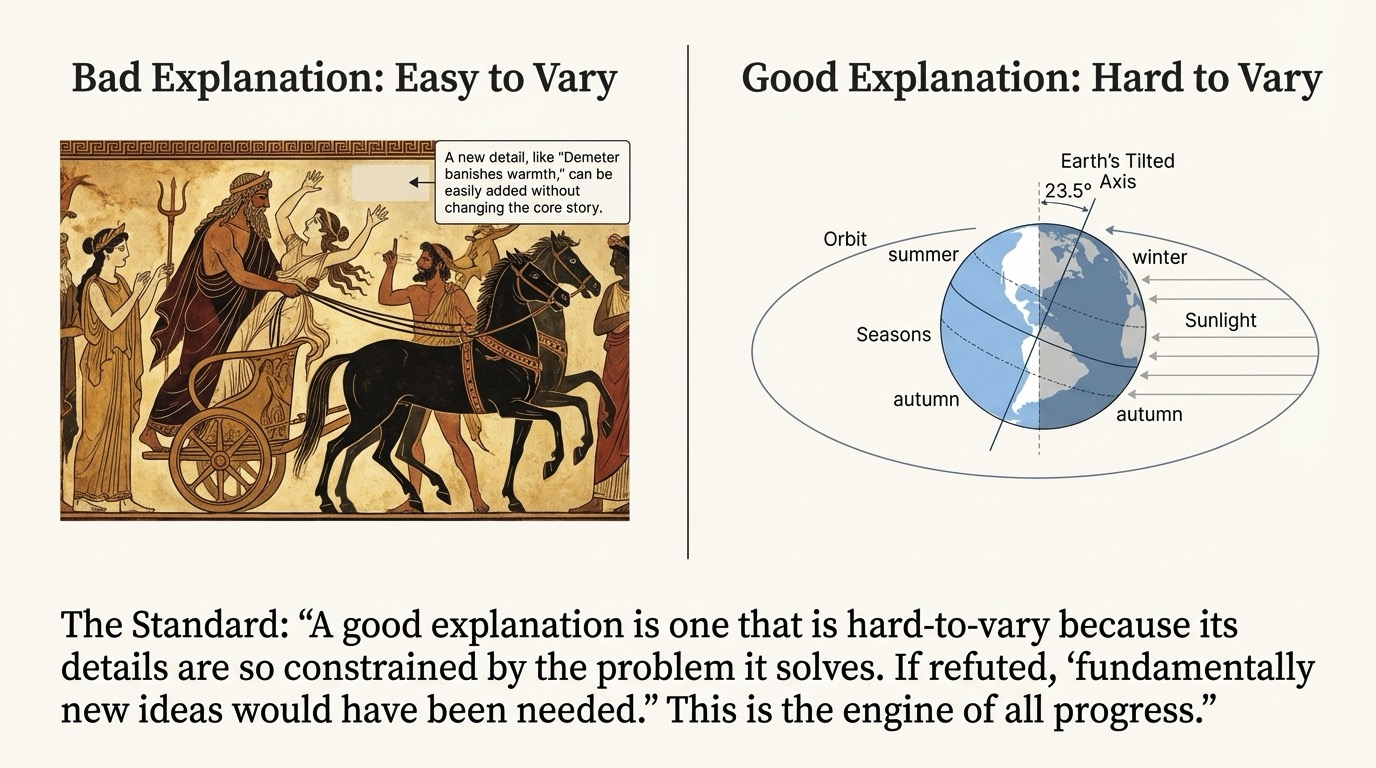
- The Standard of a Good Explanation: A good explanation is one that is hard-to-vary. To understand this, contrast two explanations for the seasons. The ancient Greek myth of Persephone’s abduction by Hades is a bad explanation. It is easy to vary: if the Greeks had discovered that seasons were out of phase in the southern hemisphere, the myth could be trivially altered to say, “Demeter banishes warmth from her vicinity, and it has to go elsewhere.” In contrast, the axis-tilt theory of seasons is a good explanation. It is hard to vary because its details are so constrained by the problem it solves. If it had been refuted, “its defenders would have had nowhere to go,” and “fundamentally new ideas would have been needed.” This is the engine of all progress.
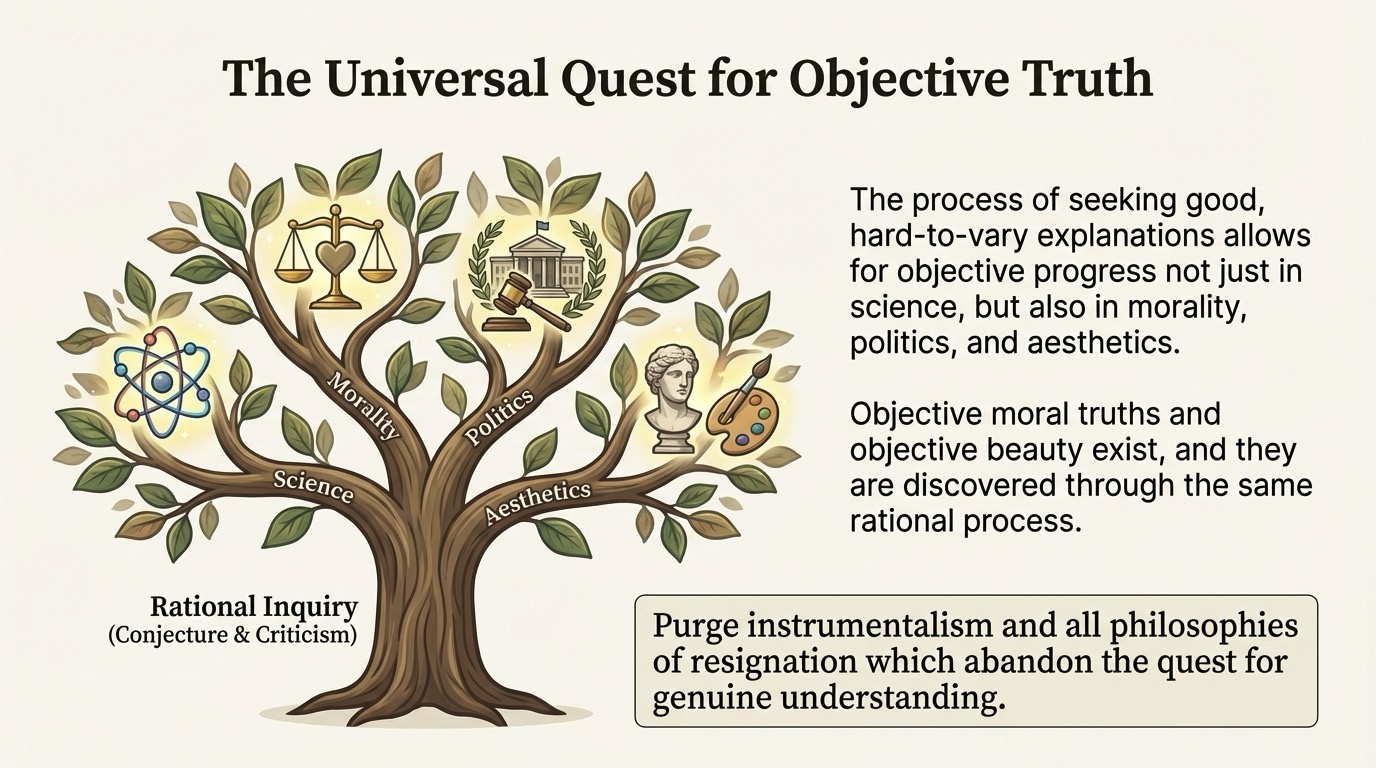
- Purge Instrumentalism and all Philosophies of Resignation. We must be realists, seeking to understand “what is there, what it does, and how and why.” Bad philosophies like instrumentalism, which claims science should only predict outcomes without describing reality, are an abdication of the intellect. They abandon the quest for explanation and therefore for genuine understanding.
- Extend the Quest for Objective Truth. The process of seeking good, hard-to-vary explanations allows for objective progress not just in science, but also in morality, politics, and aesthetics. Objective moral truths and objective beauty exist, and they are discovered through the same rational process of conjecture and criticism that drives scientific discovery.
These principles, taken together, form the cultural software required to sustain an infinite ascent of knowledge and progress.
The Choice for Infinity
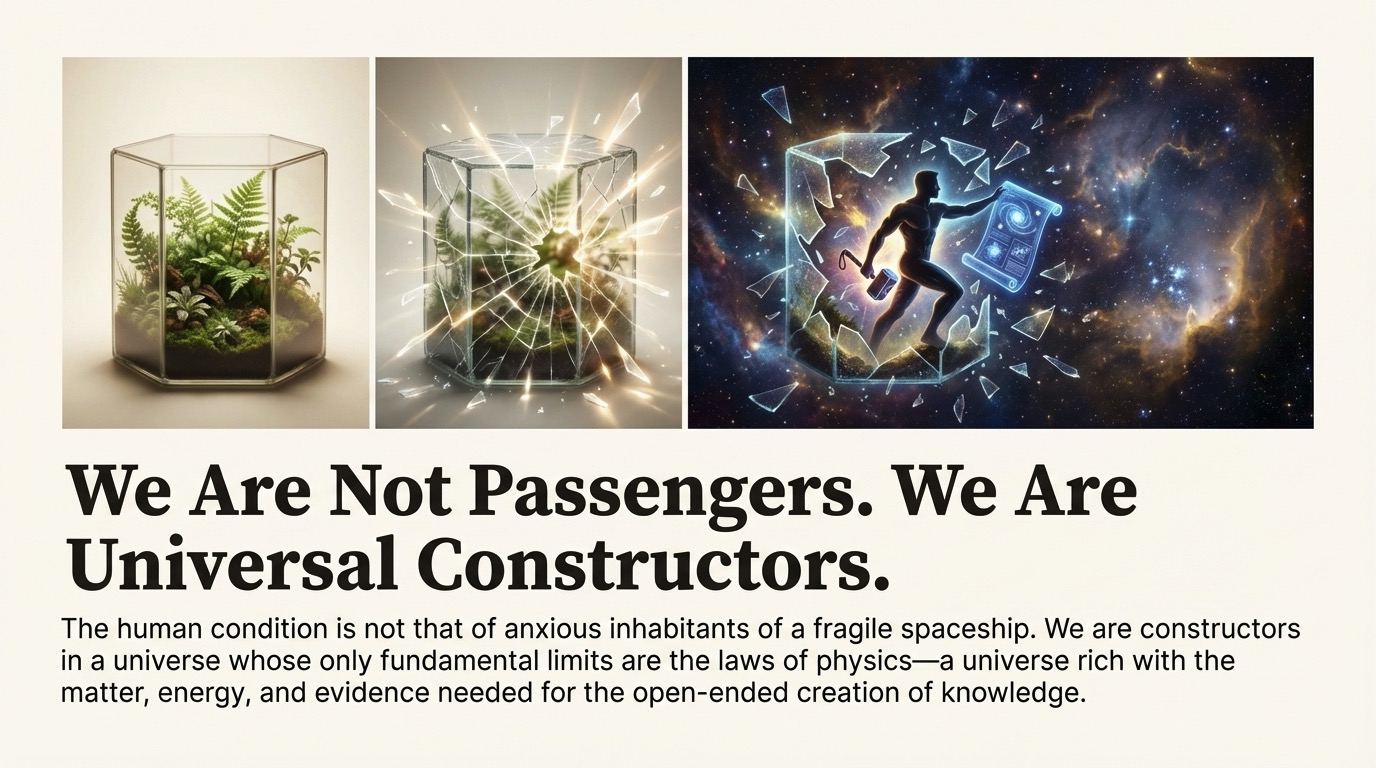
The core message of this memorandum is a call to recognise our true place in the cosmos. The human condition is not that of passengers on a fragile spaceship, anxiously guarding finite resources. We are universal constructors in a universe whose only fundamental limits are the laws of physics—a universe rich with the matter, energy, and evidence needed for the open-ended creation of knowledge.
Our future is not something to be predicted or managed according to existing knowledge, but something to be created with knowledge that does not yet exist. Prophecy is an errand that leads only to the pessimistic conclusion that progress must end.
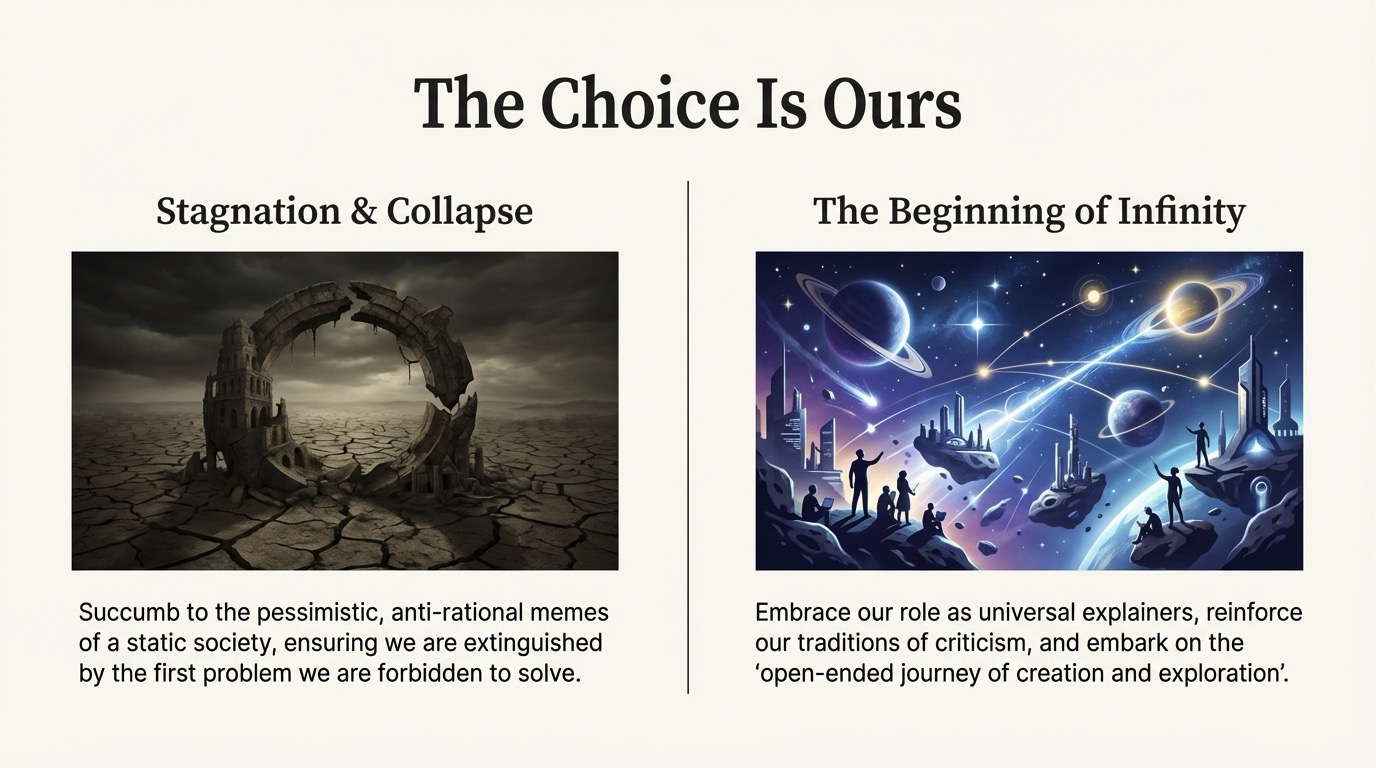
The choice before us is stark. We can either succumb to the pessimistic, anti-rational memes of a static society, crippling our unique ability to create knowledge and ensuring we are eventually extinguished by the first problem we are forbidden to solve. Or, we can fully embrace our role as universal explainers, reinforce our traditions of criticism, and embark on the “open-ended journey of creation and exploration.” This is the only sustainable path. This is the beginning of infinity.
Visuals