A Kurdish Awakening? Solidarity and the 2026 Rojava Crisis
28 January 2026
The military offensive launched in January 2026 by the Syrian transitional government against the Kurdish-led Autonomous Administration of North and East Syria (DAANES) has precipitated one of the most significant geopolitical realignments in the modern history of the Middle East. What began as an uncompromising attempt by the Islamist-led regime of Ahmed al-Sharaa to centralise power has transformed into a catalyst for a global Kurdish national revolution. This crisis, defined by a series of high-profile atrocities against Kurdish female fighters, has bridged long-standing political and geographic divides, fostering a sense of Kurdishness that transcends the factionalism of traditional party politics. The mobilisation of the Kurds in Southern Kurdistan (the Kurdistan Region of Iraq) has emerged as a potent and potential game changer, where humanitarian support, political coordination, and civil society activism have provided a new depth necessary to sustain the resistance in Rojava. In this attempt, I examine the evolution of this crisis, the symbolic power of the Braid Revolution, and the implications of a unified Kurdish national front in the face of regional and imperial shifts.
The 2026 Offensive
The transition of Syria following the fall of the Assad regime in late 2024 initially suggested a path toward a unified, if fragile, state structure. However, the rise of the Syrian transitional government (STG) under Ahmed al-Sharaa—the former leader of Hay’at Tahrir al-Sham (HTS)—shifted the political landscape toward a centralized, Islamist-oriented republic. Despite initial agreements in March 2025 to integrate the Syrian Democratic Forces (SDF) into the Syrian army, negotiations stalled throughout the year. The STG, backed by Western powers seeking stability and Turkey seeking to dismantle Kurdish autonomy, viewed the continued existence of the DAANES as an obstacle to total control.
On January 6, 2026, the pretence of diplomacy collapsed when government-aligned Arab forces attacked the Kurdish enclaves of Sheikh Maqsoud and Ashrafiyeh in northern Aleppo. By January 13, the Syrian Arab Army (SAA), supported by Arab tribal militias, launched a broader multi-front offensive across northeastern Syria. The campaign was characterised by a rapid surge into Arab-majority regions previously administered by the SDF, including Raqqa and Deir ez-Zor. Within a week, the SDF was forced to withdraw from these territories, losing control of critical oil and gas fields and the strategic Tabqa and Freedom dams.
Table 1: Chronology of the 2026 Northeastern Syria Offensive
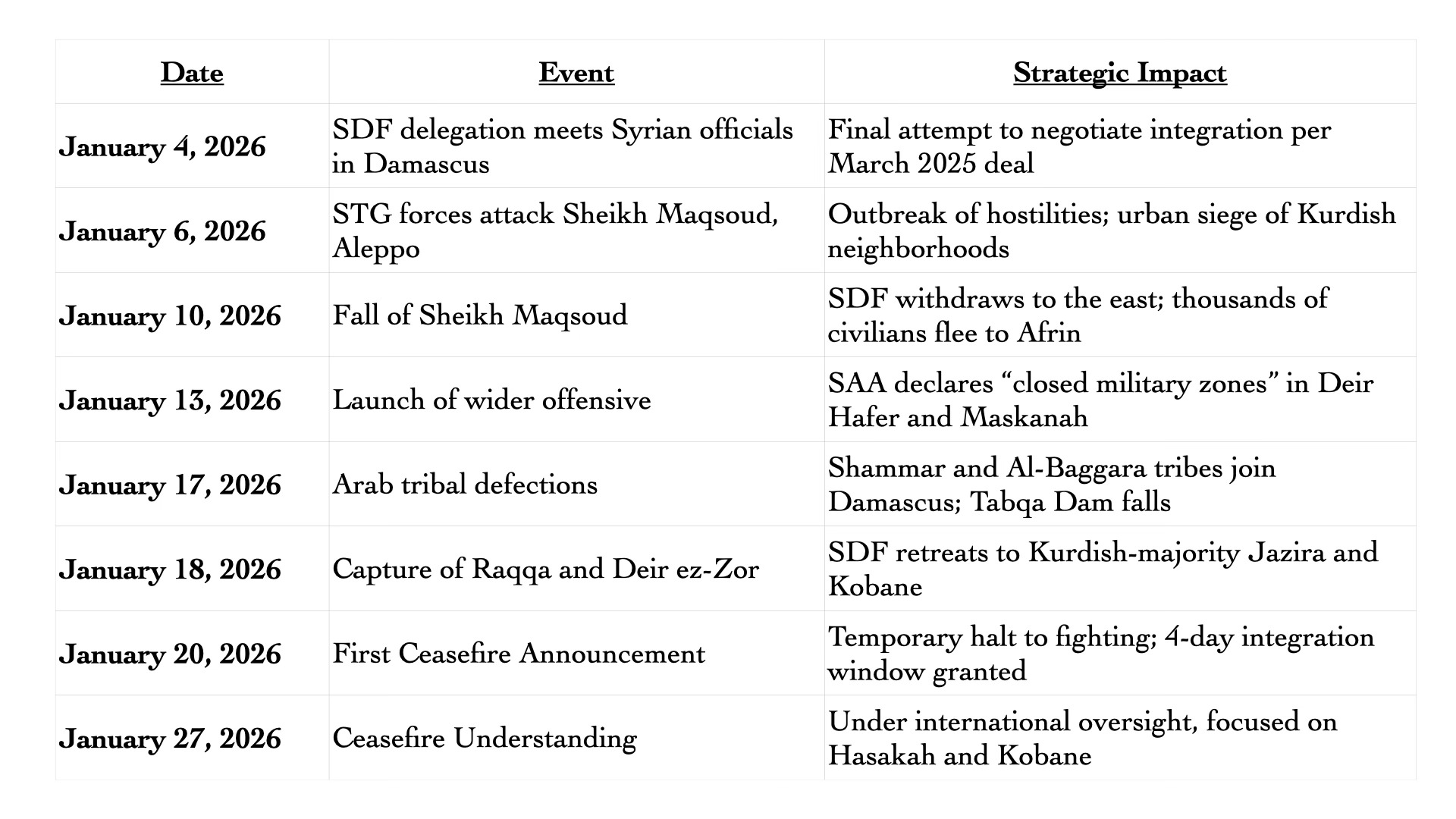
The speed of the SDF’s retreat was facilitated by a wave of defections from non-Kurdish units and tribal militias, who viewed the shifting balance of power as an opportunity to align with the central government. This “overstretching” of the SDF, which had expanded its control into vast Arab-majority regions during the war against ISIS, proved to be its greatest military vulnerability.
The Building and the Braid
The tactical military losses sustained by the Kurds were soon overshadowed by reports of extreme violence and symbolic desecration that ignited a global reactive movement among the Kurdish diaspora and within Kurdistan itself. Two specific incidents served as the emotional and symbolic triggers for this national awakening.
Denîz Ciya
On January 10, 2026, during the final stages of the battle for Sheikh Maqsoud in Aleppo, a video began circulating on social media showing a member of the Syrian government’s forces throwing the body of a Kurdish female fighter from the third floor of a bomb-damaged building. The fighter, identified as Denîz Ciya, was a member of the Women’s Protection Units (YPJ). Investigators identified the perpetrator as an Egyptian extremist fighting within a pro-government formation, raising alarms about the presence of foreign jihadist elements within the new Syrian military.
The act was condemned by the Syrian Network for Human Rights (SNHR) as a violation of international humanitarian law and a desecration of the dead. For the Kurds, the incident was more than a war crime; it was a public message intended to terrorise and humiliate Kurdish women, who had become the face of the Rojava revolution. Denîz Ciya’s death was framed as a continuation of the ISIS mentality within the new transitional government, an assessment shared by both activists and political leaders.
The Braid as a War Trophy
Days later, a second video surfaced from the Raqqa front. A militiaman identified as Rami El Dehesh was filmed holding a severed hair braid, claiming it belonged to a killed Kurdish fighter. In the footage, he mocked the deceased comrade (using the Kurdish word heval), asking rhetorically what use she had for her hair now that she was dead.
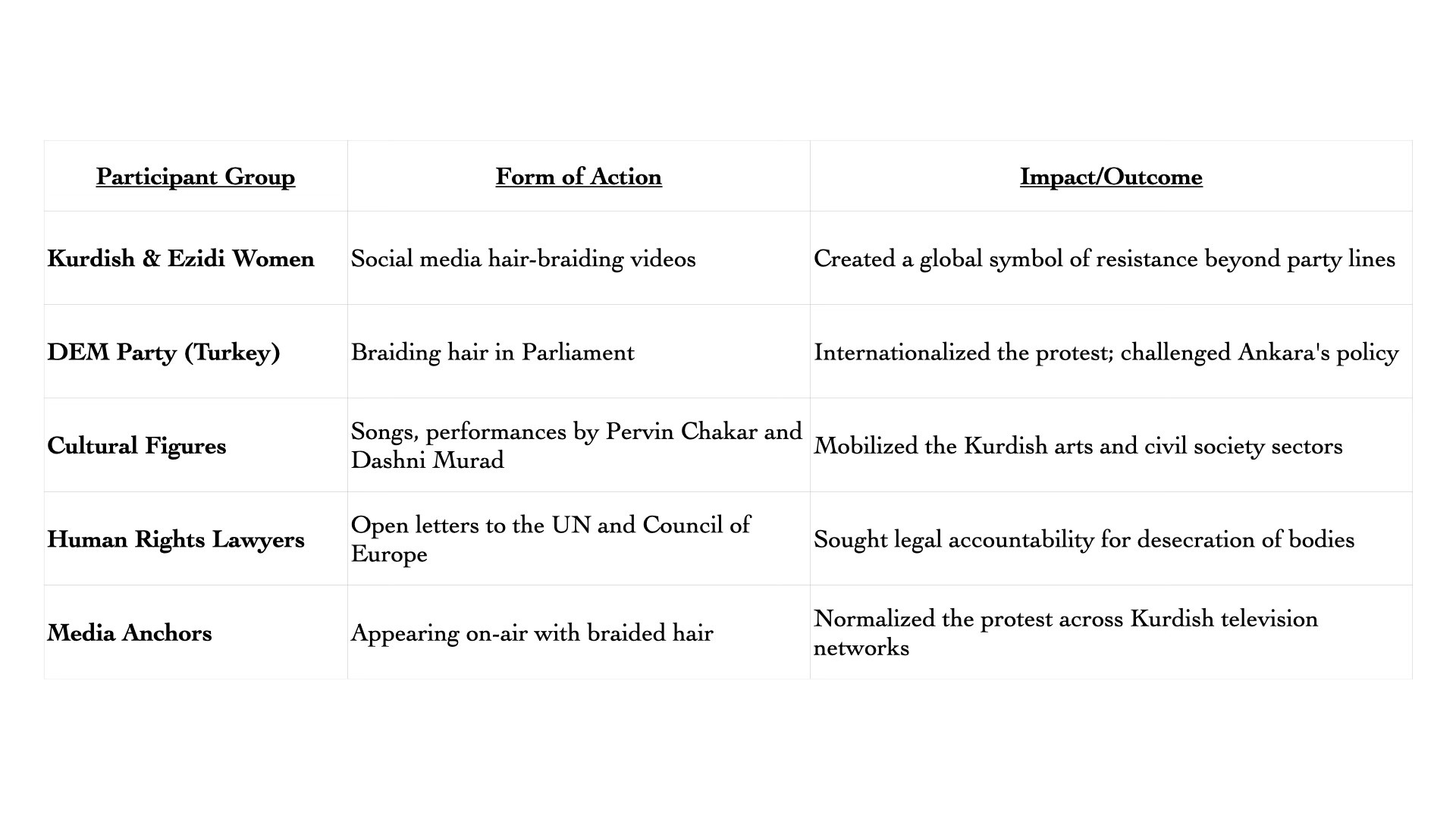
In Kurdish culture, women’s braids are deeply symbolic, representing collective memory, a connection to the land, and ancestral traditions. The display of the braid as a trophy was perceived as a direct assault on Kurdish identity and womanhood. The response was immediate and global. Kurdish and Ezidi women launched a social media campaign using the hashtags #kezî (braid) and #KeziyênMeTirsaWe (Our Braids Are Your Fear), posting videos of themselves braiding their hair as an act of defiance. This movement spread from social media to the halls of power; in the Turkish parliament, DEM Party deputies braided their hair during legislative sessions to show solidarity with Rojava.
Table 2: The Symbolic Braid Campaign and Global Solidarity
Beyond Party Politics
The reaction to the Rojava offensive has transcended the typical boundaries of Kurdish party politics. Historically, the Kurdish movement has been fractured by ideological and territorial competition, particularly between the KDP and PUK in Iraq and the PKK-aligned movements in Syria and Turkey. However, the 2026 crisis has fostered a Kurdish national continuum where the survival of Rojava is viewed as synonymous with the survival of the Kurdish people as a nation.
The Collapse of Factionalism
This new sense of solidarity is driven by the perception of an existential threat. Kurdish leaders who previously maintained a distance from the Rojava administration have been forced to align with the popular sentiment of the Kurdish streets. The movement has demonstrated that the Kurdish strategic depth lies in its geography and people, creating a force that artificial borders—imposed by the Sykes-Picot Agreement a century ago—cannot easily contain.
In Northern Kurdistan (Turkey), the DEM Party and other organisations have held mass demonstrations in border cities like Nusaybin, where protesters attempted to break through police barricades to reach the border with Qamishli. The sentiment among these protesters is clear: “Rojava is Rojhalat, Kurdistan is one nation”. This ideological shift represents a move from “transactional politics” to a “unified political front” aimed at collective survival.
Popular Mobilisation in Rojava
Within the Kurdish heartlands of Rojava, the response has been a total call to arms. In the city of Qamishli (Qamişlo), the municipality announced a general mobilisation, leading to scenes where grandmothers and granddaughters armed themselves to defend their neighborhoods. The Civil Defense Units (HPC) have taken over nightly patrols, successfully identifying and arresting sleeper cells supporting the STG. The spirit of “Resistance is life” (Berxwedan Jiyan e) has redefined the conflict from a military defense into a popular revolution against an ISIS-like regime.
Southern Kurdistan: The Strategic Game Changer
The mobilization of the Kurds in Southern Kurdistan (the Kurdistan Region of Iraq) has emerged as the most significant strategic development of the crisis. As the only autonomous Kurdish region with an official government, a modern military (the Peshmerga), and significant economic resources, its support for Rojava has shifted the regional calculus.
Mass Protests and Public Sentiment
Since January 19, 2026, thousands of protesters have filled the streets of Erbil, Sulaymaniyah, Duhok, Zakho, and Soran. In Erbil, a massive demonstration in front of the U.S. Consulate General expressed “strong dissatisfaction” with Washington’s perceived silence and abandonment of its Kurdish partners. Protesters waving the flag of Kurdistan have demanded that the international community intervene to prevent what they termed a “massacre” in Western Kurdistan.
In Soran and Zakho, the chants of “The day is our day” and” “Rojava is not alone” have signaled a psychological shift among the population. This popular pressure has compelled the KDP and PUK leadership to set aside internal disputes over the formation of the 10th regional cabinet to address the Rojava crisis collectively. PUK leader Bafel Talabani condemned the offensive as “unacceptable,” while KDP leader Masoud Barzani warned that the instability would lead to an ISIS resurgence that would threaten the stability of the entire region.
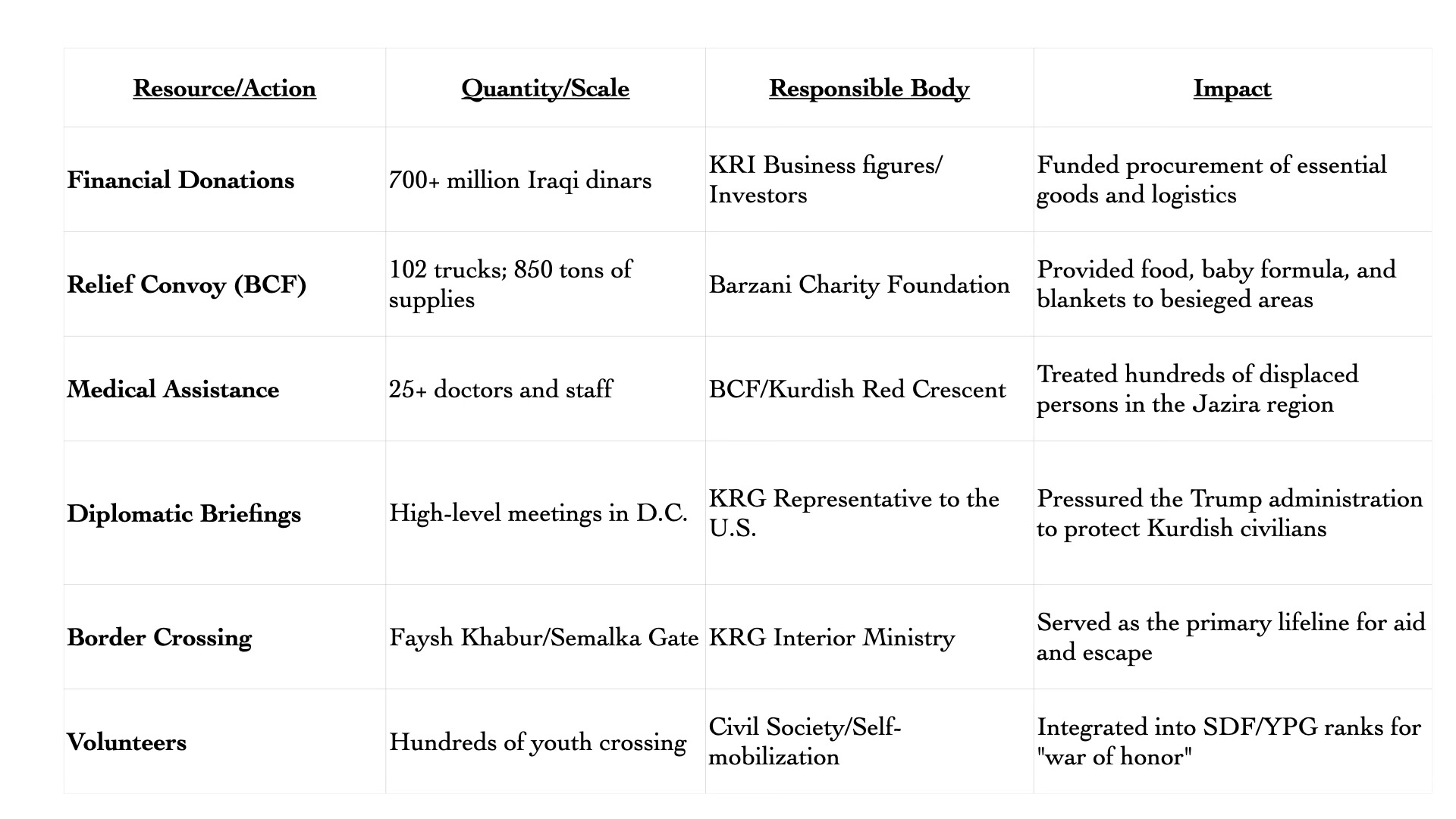
Table 3: Humanitarian and Strategic Support from Southern Kurdistan (KRG)
The Humanitarian Pipeline
The Kurdistan Regional Government (KRG) has utilized the Faysh Khabur (Semalka) border crossing as a vital lifeline for Rojava. Despite the Syrian government’s attempts to encircle Kurdish cities like Kobane and Hasakah, the KRG has facilitated the delivery of hundreds of tons of food, medical supplies, and winter provisions. The Barzani Charity Foundation (BCF) has been central to this effort, sending heavy transport trucks loaded with winter supplies to combat the most severe winter in half a century.
In Kirkuk, a community-driven initiative saw residents assemble 15 trucks carrying 250 tons of food, demonstrating that support for Rojava extends even to the disputed territories of Iraq. The KRG Interior Ministry has mandated that all aid be delivered through official channels to ensure logistical efficiency and prevent unauthorised crossings that could provoke the STG or Turkey.
Youth Volunteers and Solidarities
Perhaps the most potent aspect of the Southern Kurdish mobilisation is the influx of youth volunteers. Reports from the Semalka border gate indicate that hundreds of young men and women from cities across the KRI have crossed into Rojava to join the resistance. These volunteers have declared their intention to “take their place in the ranks of resistance,” viewing the defense of Qamishli and Kobane as a personal duty.This cross-border military participation represents a “strategic necessity” that turns a localised Syrian conflict into a pan-Kurdish war of survival.
The Siege of Kobanê and the Betrayal of the West
The city of Kobanê, which became a global symbol of Kurdish triumph over ISIS in 2015, is once again under a “suffocating siege.” This time, the threat comes not from ISIS, but from the Syrian Arab Army and its allied Islamist militias.
The Humanitarian Catastrophe
As of late January 2026, Kobanê is surrounded by the Turkish border to the north and government forces on all sides. The siege has resulted in acute shortages of food, water, and heating fuel. Four Kurdish children have reportedly died from cold exposure, as families are forced to melt snow for water in freezing temperatures. The Kurdish Red Crescent has characterized the situation as “catastrophic,” noting that many internally displaced persons (IDPs) are trapped in the city center without adequate shelter.
International Actors
The Kurdish people feel a profound sense of betrayal by the United States and other Western allies. The U.S. relationship with the SDF, which was the cornerstone of the fight against ISIS for a decade, appears to have been sacrificed for broader diplomatic calculations involving the new al-Sharaa regime. While U.S. envoy Tom Barrack and Senator Lindsey Graham have called for the protection of Kurdish civilians and the reintroduction of sanctions (the “Save the Kurds Act”), the ground reality indicates a “green light” was given for the STG’s offensive.
Turkey, too, remains a critical player. Ankara has openly supported the al-Sharaa administration’s push to dismantle Kurdish self-rule, viewing the DAANES as a “fifth column” and a threat to its territorial integrity. Turkish drones have consistently struck Kurdish infrastructure, including medical centers and internal security checkpoints, even during declared ceasefires.
Strategic Implications and Future Outlook
The 2026 Rojava crisis has permanently altered the internal dynamics of the Kurdish movement and its relationship with the surrounding nation-states.
The Centralisation of Kurdish Identity
The Braid Revolution and the atrocities in Aleppo have done what decades of political dialogue could not: they have unified the Kurdish people under a single national identity that transcends party affiliation. This new Kurdishness is rooted in shared trauma and shared resistance, positioning the Kurds as a unified regional actor. This shift is likely to have long-term consequences for Turkey, Iran, and Iraq, as Kurdish political energy is no longer contained within state-specific frameworks.
The Survival of Rojava
The experimental model of Democratic Confederalism—based on feminist, ecological, and pluralistic principles—is facing its most severe test. While the SDF has ceded significant territory, the popular mobilization in the Kurdish heartlands suggests that the revolution has moved from a military administration into a deep-rooted social reality. Even if the STG achieves a formal military victory, it will face a population that has been fundamentally transformed by 14 years of self-governance.
Southern Kurdistan as a Regional Pivot
The role of the KRG as a game changer has solidified its position as the guarantor of Kurdish interests. The successful coordination between Erbil and Washington, and the popular mobilization across the KRI, has demonstrated that the Kurds can exert significant regional pressure when they present a unified front. The “strategic depth” provided by the KRG—humanitarian, diplomatic, and military—is now the primary factor preventing the total collapse of Rojava.
In conclusion, the events of early 2026 have sparked a national awakening that has redefined the Kurdish struggle. The atrocities of the Syrian transitional government have inadvertently fuelled a revolution of solidarity, making Kurdishness a powerful source of agency beyond the divisions of state and party. As the siege of Kobanê continues and the diplomatic landscape shifts, the Kurds have demonstrated that their strategic strength lies not in foreign alliances, but in their own unity and the shared spirit of resistance that bridges Rojava and Southern Kurdistan.


