A Chasm of Delusion: Hamas’s Rhetoric in the Face of Strategic Reality
10 December 2025
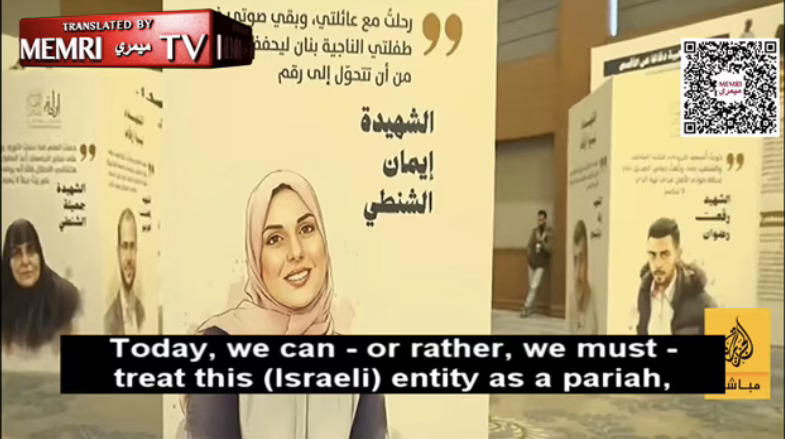
Source: Memri
Angels Refuse to Disarm
A sheer, celestial irony is that on 6 December 2025, the strategic debate surrounding the continuation of the Israeli-Palestinian conflict reached a surreal crescendo, with the voices of both sides broadcasting simultaneously from irreconcilably different realities—one must truly admire the sheer, unblinking audacity of Khaled Mashal, the Head of Hamas Abroad, addressing his congregation of scholars, scientists, and thinkers at the Istanbul Pledge to Jerusalem Conference, having just presided over the comprehensive strategic annihilation of every Iranian proxy in the region. Here was the exiled leader, arguing with the pious fervour of an accountant auditing the Apocalypse, that rights are secured not in the contemptible chambers of the UN Security Council, but “at the recruitment office,” while strategically dismissing diplomacy and delivering the zenith of his counsel in the theological reassurance that, after two full years of military confrontation, “the angels have not laid down their weapons yet”—one naturally wonders, given the Israeli Air Force’s documented technological mastery via the F-35I Adir, a “game-changing platform” complete with customised Elbit electronic warfare suites, whether their fifth-generation sensors, which penetrated the most heavily defended airspace on the planet with “no equipment or personnel losses,” have perchance managed to secure high-resolution infrared imagery of these perpetually armed celestial bodies. Yet, precisely on the same date, Israel’s Channel 11 released its highly anticipated documentary, “UNRWA: The Engine of Palestinian Return,” which systematically exposed the “womb that gave birth to Palestinian nationalism” and its ultimate ideological objective: the “Palestinian dream is to wake up one morning to an Arab state from the river to the sea—without Jews,” asserting that the October 7th massacre was the very “deepest realization of the Palestinian dream of return,” a deadly, earthly ambition that UNRWA had spent 75 years perpetually engineering. This divine coincidence juxtaposed Mashal’s reliance on unseen, armed heavenly forces—which presumably the Israeli F-35s had failed to log—with the profound disconnect between such a celestial battlefield claim and the empirical, devastating reality of Israel’s 90% mission readiness rate and their decisive ability to destroy over half of Iran’s missile arsenal, precisely the measure of the lethal delusion that the subsequent analysis must relentlessly dissect.
A Declaration Divorced from Reality
In the grand conference halls of Istanbul, in December 2025, the exiled leader of Hamas, Khaled Mashal, delivered a keynote address brimming with the rhetoric of victory. Before an audience of supporters, he spoke of an unending battle, of glorious resistance, and of a world stage prepared for the ostracism of Israel. His words painted a picture of a triumphant movement on the cusp of achieving its ultimate aims.
Let us bring in reality to his “strategic worldview” by juxtaposing Mashal’s declarations against the documented military, technological, and geopolitical realities of the preceding two years. The objective is not merely to expose a disconnect, but to dissect a rigid mental model that has proven to be not only delusional but self-destructive on a civilisational scale. What emerges is not a portrait of a successful resistance, but a chasm of delusion, where a worldview impervious to facts guides a movement, and a people, towards strategic oblivion.
The World According to Mashal
To comprehend the strategic dissonance at play, one must first clearly articulate the worldview presented by Khaled Mashal. His December 2025 speech is not merely political posturing; it is the public expression of a deeply held ideological framework that defines the conflict, justifies the means, and predicts the outcome. Below are the core tenets of his address, presenting his perspective as the foundation for the subsequent analysis.
The Unending Battle and the Rejection of Guardianship. For Mashal, the ceasefire declared two months prior was a mere pause in a perpetual conflict. He asserted that despite the cessation of major hostilities, “the battle is not over,” insisting that plots against the Palestinians were “still underway.” This framing rejects any notion of a political settlement or a final resolution, casting the struggle as an eternal condition.
Central to this vision is an absolute rejection of any external control over Gaza. Mashal declared unequivocally, “The Palestinians will govern themselves and will make their own decisions.” He was explicit in his dismissal of international or regional oversight, stating there would be “no guardians, no mandate, and no renewed occupation,” arguing that his people required “protection, not guardians.”
The Sanctity of Armed Struggle. Mashal’s ideology is anchored in the glorification of violence as the sole legitimate instrument of statecraft. “The resistance and its weapons,” he proclaimed, “are the honor and glory of the Islamic nation.” He contemptuously dismissed diplomatic avenues, arguing that rights are not won via the “Security Council, but through the recruitment office.” This worldview posits that force is the only language of power and the only path to liberation.
This belief is the modern culmination of a narrative nurtured over generations. As detailed in a documentary on the United Nations Relief and Works Agency (UNRWA), this ideology has been central to constructing a Palestinian collective identity around a perpetual state of conflict. Analyst Einat Wilf’s assessment that “October 7 is the deepest realization of the Palestinian dream of return” provides the essential context for Mashal’s praise of the attack. It was not merely a military operation but the fulfilment of a foundational, 75-year-old dream kept alive by an international organisation and a culture of resistance.
October 7th as a Geopolitical Triumph. In Mashal’s strategic calculus, the October 7th attack was an unmitigated success that reshaped the global landscape. He argued that “The [al-aqsa] flood, with its might, has prepared the international arena” to treat Israel as a “pariah” state, responsible for a “genocidal war.” This perspective interprets the international condemnation of Israel’s response not as a consequence of Hamas’s own actions, but as a strategic victory engineered by the attack itself.
The ultimate ambition, as Mashal plainly stated, is existential. He declared that the attack created an “opportunity to build on this in order to expel this [Israeli] entity from our homeland, and to ostracise it from the international stage.” This is not a call for a two-state solution or a negotiated peace, but for the complete erasure of Israel from the map and from the community of nations.
Having established this ideological vision, this analysis will now test it against the documented strategic, military, and geopolitical outcomes of the conflicts initiated by the very attack he celebrates.
The Reality of the Battlefield
Let me share with you a systematic demolition of Khaled Mashal’s delusional narrative. In stark contrast to his claims of a successful resistance, the period from 2023 to 2025 witnessed the annihilation of every pillar of Iran’s “Ring of Fire” strategy that Hamas claimed to serve. Strategic assessments detail the comprehensive and devastating military defeats inflicted upon Hamas, its regional allies, and its primary state sponsor, Iran.
The Decimation of the Ring of Fire. Iran’s long-term strategy of encircling Israel with proxy armies was not merely challenged; it was systematically dismantled.
Hamas: The war in Gaza, initiated by the October 7th attack, ended in the strategic annihilation of Hamas as a military and governing body. The campaign’s stated objective was to dismantle the military and governing capabilities of the organisation. As noted by military analyst Edward Luttwak and cited in Arthur Herman’s account of the war, the IDF’s estimated 50-to-1 kill ratio against Hamas combatants was an incredible measure of success, underscoring the finality of the group’s military defeat.
Hezbollah: In Lebanon, Iran’s most powerful proxy is crippled. The campaign began with a devastatingly creative Mossad covert operation that compromised thousands of Hezbollah pagers and continued with precision airstrikes that eliminated its senior leadership, including Secretary General Hassan Nasrallah and his designated successor, Hashem Safieddine. The JINSA strategic report concludes that Israel’s campaign reduced Hezbollah’s second-strike capability—its primary value to Iran—to “all but zero.” As I have wryly observed, there is a profound irony in the fact that the “Party of allāh” (hizb allāh), led by the “Victory of allāh“ (nasr allāh) and the “Pure of the Religion” (safī ad-dīn), were brought low with such precision.
The Wider Axis: The collapse of the proxy network extended across the region. Following the fall of the Assad regime, Israel eliminated remaining Syrian conventional capabilities that posed a threat. Concerted operations also degraded the capabilities of the Houthis in Yemen. By mid-2025, Iran’s entire encirclement strategy, the product of decades of investment, lay in ruins.
The Decapitation of the Patron: Operation Rising Lion. The ultimate refutation of Mashal’s delusion of resistance was the 12-day air campaign against Iran itself in June 2025. Described in the JINSA analysis as a “flawless” operational masterpiece, the campaign was a demonstration of “intelligence dominance” and “air superiority” executed with “no equipment or personnel losses.” The strikes methodically decapitated Iran’s military and scientific leadership, throwing the regime’s command and control into disarray within the opening minutes of the war.
Key Iranian Leadership Eliminated: General Hossein Salami: Commander-in-Chief, IRGC. General Amir Ali Hajizadeh: Commander, IRGC Aerospace Force. General Mohammad Hossein Bagheri: Chief of Staff, Iranian Armed Forces. General Gholam Ali Rashid: Head, Khatam al-Anbiya Central Headquarters.
Operationally, the campaign was catastrophic for Iran. Israeli strikes destroyed over half of Iran’s missile arsenal, and a coordinated effort with the United States, codenamed Operation Midnight Hammer, saw American B-2 bombers and cruise missiles smash Iran’s core nuclear facilities at Natanz and Fordow, burying Tehran’s nuclear ambitions.
The Technological Chasm. These military victories were not accidental; they were the product of a vast and growing technological and logistical chasm between Israel and its adversaries.
The game-changing platform was Israel’s modified F-35I Adir. Israeli engineers transformed the standard American fighter by integrating an extended-range capability with conformal fuel tanks and a customised Elbit electronic warfare suite. This allowed the jets to penetrate the most heavily defended airspace on the planet, neutralise advanced Russian S-300 systems, and return to base without a single loss.
This technological edge is underpinned by a deep, systemic advantage in sustainment. While the U.S. F-35 fleet suffered from a 51.5% mission-capable rate, Israel maintained an astounding 90% readiness rate during active combat. This was achieved through an autonomous depot-level maintenance facility that bypasses the bureaucratic bottlenecks of the international programme.
In this context, Khaled Mashal’s call for his followers to find their rights at the “recruitment office” is a directive to wage a 20th-century war of manpower against a 21st-century, network-centric adversary—a strategy not for victory, but for annihilation.
Having examined the stark reality of the battlefield, this analysis will now turn to the geopolitical arena to assess Mashal’s claim that Israel would become a global pariah.
The Geopolitical Aftermath
Khaled Mashal’s central geopolitical thesis was that the October 7th attack would galvanise world opinion and turn Israel into an isolated “pariah.” Strategic analyses of the conflict’s aftermath reveal a diametrically opposite outcome. Instead of triggering isolation, the wars of 2023-2025 shattered old paradigms and catalysed the creation of a new regional architecture with a stronger, more integrated Israel at its core.
The Failure of the Pariah Strategy. The prediction that the war would isolate Israel proved to be a profound miscalculation. As I have noted, the conflict, contrary to Hamas’s hopes, “accelerated the alignment Sinwar hoped to destroy.” The demonstration of overwhelming Israeli military capability against a shared Iranian threat proved far more compelling to pragmatic Arab states than the opinions of “Western university students.”
This realignment was not merely diplomatic. The war prompted deeper, if often covert, military integration between the IDF and pragmatic Arab armies, a process actively facilitated by U.S. Central Command (CENTCOM). Shared intelligence and operational coordination became the new reality, forged by the mutual recognition of the threat posed by an expansionist Iran and its proxies.
The Creation of a New Geopolitical and Economic Reality. The most significant outcome of the conflict was not destructive but creative—an act of what I, citing game theorist James P. Carse, call poiesis: the forging of new strategic possibilities. This creative act is the ultimate objective of an “infinite player” in a geopolitical contest. By decisively eliminating the Iranian threat, Israel fundamentally altered the game board itself.
It solidified its position as the indispensable “geographic hinge” of the nascent India-Middle East-Europe Corridor (IMEC), an economic framework that emerged as a powerful alternative to China’s Belt and Road Initiative, anchoring a new geoeconomics map with Israel at its centre. This new reality, built on demonstrated hard power and shared interests, rendered previous political frameworks obsolete. As Arthur Herman concludes, Israel’s decisive actions made “the Israel boycott movement, and the siren calls for a Palestinian state... irrelevant.” By changing the rules, Israel forced every regional and global player to adapt to a new board of its own making.
The geopolitical outcome was not the isolation of a pariah state, but the consolidation of a regional power. This divergence between expectation and reality can only be explained by examining the fundamentally different strategic mindsets at play.
A Tale of Two Mindsets
The vast gulf between Khaled Mashal’s delusional rhetoric and the documented reality of 2023-2025 is not simply a matter of propaganda. It is the product of two fundamentally different approaches to conflict and strategy. Where Israel’s cognitive shock forced a radical update to its strategic Model, Hamas’s worldview proved pathologically incapable of adaptation.
Israel: From Cognitive Collapse to Antifragile Renewal. The October 7th attack was, by Israel’s own admission, a “catastrophic cognitive failure.” A flawed strategic concept, or conceptzia, regarding a “deterred” Hamas led to a profound national trauma. In the language of cognitive science, this shock was a massive “prediction error”—a violent collision between Israel’s mental model of the world and reality. For a rigid actor, such a blow could be fatal. For Israel, however, it acted as a catalyst for radical adaptation. As an “infinite player” whose ultimate objective is not to win a single war but to continue the game of survival, the shock forced a complete update of its strategic model. The subsequent military campaigns were a series of “finite games”—wars with clear objectives—waged not as ends in themselves, but as decisive moves to strengthen Israel’s long-term position. The state leveraged a moment of supreme vulnerability and transformed it into a trigger for strategic and geopolitical renewal, demonstrating the antifragility that comes from the ability to learn from catastrophic prediction errors.
Hamas: A Worldview Impervious to Reality. Khaled Mashal’s December 2025 speech stands as testament to a worldview pathologically incapable of learning. His declarations reveal a strategic model that remains frozen in the reality of October 6th, 2023, seemingly unable to process or acknowledge the devastating consequences of the al-aqsa flood. His continued focus on the “glory” of a single tactical operation while ignoring the subsequent strategic annihilation of Hamas, Hezbollah, and their Iranian patron is the hallmark of a finite player who has fundamentally misread the game. This ideological rigidity is not an isolated failure but the logical culmination of a 75-year narrative of “return,” actively perpetuated by institutions like UNRWA, which primes the political culture for such a disconnect from reality. Hamas’s fragility, therefore, is rooted in a narrative that is, by design, hermetically sealed; no amount of contradictory evidence can penetrate it.
The Lethal Cost of Delusion
Khaled Mashal’s address in Istanbul was not a reflection of strategic reality or re-assessment but a damning indictment of strategic malpractice. It was an ideological pronouncement from a strategic cul-de-sac—a closed and self-referential narrative from which there is no escape. The staggering disconnect between his call for continued struggle and the on-the-ground reality of total strategic defeat for his organisation and its allies is the core of a lethal delusion.
In the preceding two years, the adversary Hamas sought to make a “pariah” had systematically dismantled its entire military structure, decapitated its patron, and leveraged the conflict to become more technologically advanced, militarily dominant, and geopolitically integrated than ever before. By exhorting his followers to continue a war against this revitalised and strengthened opponent, Mashal is not leading a resistance; he is perpetuating a tragedy. He is asking a people to sacrifice their future for a narrative that has been empirically and brutally falsified. This is the ultimate cost of a worldview that values ideological “honor” above survival, and delusion above reality.
Thus, the ultimate verdict on Khaled Mashal’s strategic vision is sealed not merely by the catastrophic 50-to-1 kill ratio achieved in Gaza or the smoking ruins of Iran’s nuclear programme, but by the very scripture he weaponised. The full injunction of surah al-anfāl (8:60), which Mashal partially quoted to insist that rights are regained “at the recruitment office,” demands the preparation of “whatever you are able of power and of steeds of war by which you may terrify the enemy of allāh and your enemy and others besides them whom you do not know [but] whom allāh knows.” Mashal’s profound failure, and the ensuing madness of their position, is that the strategic output of the “Axis of Resistance” proved laughably incapable of meeting this comprehensive demand for overwhelming, terrifying strength. Instead of mustering the necessary power to “expel this [Israeli] entity... from the international stage,” the confrontation merely provided the necessary “prediction error” that enabled Israel to deploy its F-35 “ecosystem of innovation” and consolidate its position as the “dominant military power in the region” (as noted above). The result, far from terrifying the Jewish state, was the spectacular annihilation of the proxies and the validation of Israel’s new strategic autonomy—a crushing irony confirming that the dream of return, which Mashal celebrated as the “deepest realisation” of Palestinian ambition, remains confined to ideological propaganda and retained “key[s] of return,” a pitiful substitute for the terrifying force the holy text so relentlessly demanded.
References:
Channel 11, 20251206, “UNRWA: The Engine of Palestinian Return.” www.youtube.com/watch?v=xc6hwAoqsW0&t=4s
Memri, 20251206, “Top Hamas Official Khaled Mashal” https://www.memri.org/tv/khaled-mashal-hamas-battle-israel-october-7
Khaled Salih, 20251129, “An Antifragile State: Israel’s Strategic Consolidation in the Wake of Conflict. Updated Analysis: 29 November 2025.” https://khaledsalih.substack.com/p/an-antifragile-state-israels-strategic
— 20251125, “Israel: From Cognitive Collapse to Antifragile Consolidation.” https://khaledsalih.substack.com/p/israel-from-cognitive-collapse-to
— 20251124, “The October 7th Catastrophe: Systemic Failure Through a Cognitive Lens.” https://khaledsalih.substack.com/p/the-october-7th-catastrophe-systemic


